
Rems and Winterbach · River, water, nature and history
The first Rems surfer?
Let us say it straight away: there is no evidence that any person ever rode a wave on the Rems before surfboards existed. No file mentions it, no chronicle, no picture. This page is a thought experiment – honestly labelled as one. But it is a thought experiment with a surprising number of real ingredients. This is chapter 4, the close of our search → The forgotten wave of Winterbach.
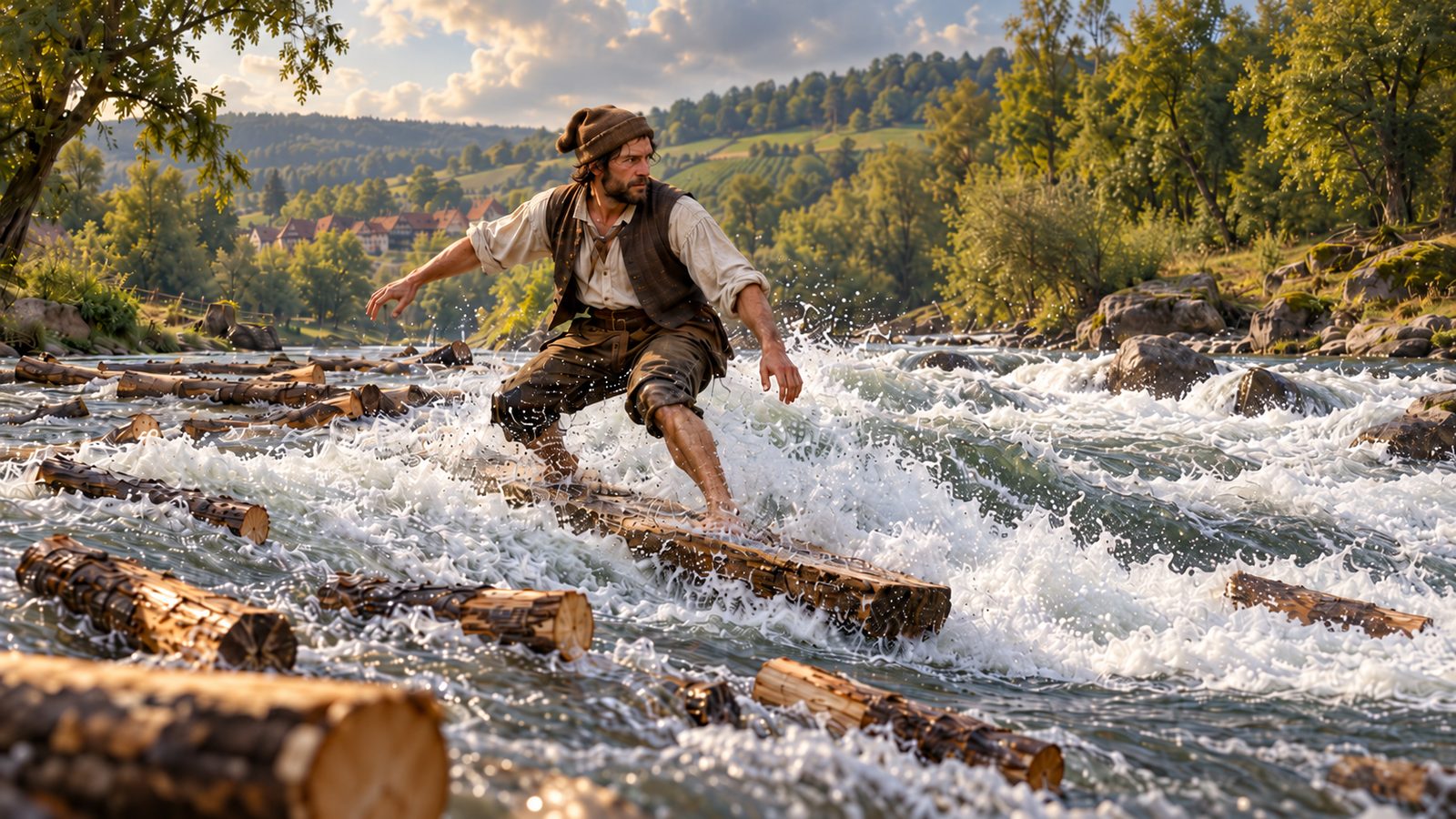
Ingredient 1: people stood on floating timber – elsewhere
Standing on floating wood is not a modern idea. In North American log driving it was part of the trade: the most experienced men of the "jam crews" ran across floating logs to break up jams – work the records describe as exceedingly dangerous, and which cost many lives. Out of it later grew log rolling as a competitive sport. In Alpine timber drifting too, men climbed onto log jams to get them moving again. We assume that on the Rems as well, people stood on floating timber where it was big enough – to free stuck wood, for instance.
But: the Rems files describe the opposite. The "boot men" stood in the water and worked with hooks – nobody can stand on short firewood billets. → When the Rems carried firewood
Ingredient 2: it was not only small wood that floated
The millers' ordinance of 1627 required the chutes to pass "Zimmer-Geschnitten oder Scheitter-Holtz" – expressly including construction timber, larger pieces. And long timbers floated in the operation anyway: when the installations were sold off in 1863, fir long timber was among the lots. Whether such pieces regularly came down the Rems or only served as equipment, our sources do not say – it is one of the questions we are pursuing in the files. But if anyone ever stood on floating wood on the Rems, it was on a piece like that.
Ingredient 3: a board, a river, a wave – that really happened
The idea of riding a river wave on a board is older than modern surf tourism. In 1955 a British officer rode the tidal bore of the Severn in Gloucestershire – on a home-built board a good four metres long. The Museum of British Surfing lists the ride as thought to be the world's first on a tidal wave in a river. In Munich, river surfing as we know it took shape from the 1970s at the Floßlände and the Eisbach. → Where rivers become surfable by themselves
And now the thought experiment
Picture a drift around 1750. Water has been released from the Ebnisee, the Rems runs high, the stop logs at the Winterbach mill weir are pulled, and water and wood shoot through the rafting chute. Behind the chute, where the fast water meets the slow, the river throws a roller – day and night, as long as the drift runs. On the bank stand drift hands, wet, tired, hooks in hand. And one of them – young, cocky, perhaps on a Sunday when the throwing-in paused – pushes a long construction timber into the slack water, climbs on and poles himself towards the roller …
Here ends what we are allowed to tell. Whether the chute threw a wave at all, we do not know – it depends on its build, which we are hunting for in the archives. → The riddle of the rafting chute Whether anyone ever dared the attempt, we know even less. And the physics is incorruptible: whoever stands on drifting wood floats along with the current – that is balancing, not wave riding. "Surfing" in today's sense happens only where the water runs through beneath you: on a standing wave. The big timber, then, would have been the candidate for the board – the rafting chute the candidate for the wave. Did the two ever meet? Some questions are too good not to ask.
Frequently asked questions
Is the picture above real?
No. It is an AI-generated visualisation, clearly labelled as such – as we do with all visualisations on this website. We know of no historical depictions of the Rems drift; the surviving archive drawings show dams and chutes, not people on the water.
Why tell a story that is not documented?
Because we tell it as what it is: a thought experiment on a documented stage. Drift, flushing ponds and rafting chute are on record; the surfer is imagination. That separation is stated on every page of this series. History comes alive when you imagine people in it – as long as you say honestly where the sources end.
Was there "surfing" anywhere before surfing?
On the sea: yes – the wave riding of Polynesia and Hawaii is centuries old. On Europe's rivers no surfing attempts are documented before the 20th century, though board and balancing games on and in the water certainly existed. The documented history of river surfing begins with the Severn ride of 1955 and the Munich waves from the 1970s.
Sources: Museum of British Surfing: timeline, entry on the 1955 Severn ride · Wikipedia: Log driving (with literature) · Uwe Jens Wandel, "Zur Flößerei auf Rems und Wieslauf" (1987): boot men, the 1863 sale · Millers' ordinance of 1627, cited after Wandel · → The riddle of the rafting chute · → How a standing wave forms
Last updated: 15 October 2026 · Initiative Remswelle