
Rems and Winterbach · River, water, nature and history
Too many bees? Do honeybees crowd out wild bees on the Rems and the Hungerberg?
Can there be too many honeybees? Beekeepers do not like to hear the question, but it is a fair one. Honeybees are livestock: they are kept, cared for and looked after in winter. Wild bees, bumblebees and butterflies live on the same flowers, but nobody feeds them. The short answer: it depends – on the number of colonies, on the season and on how much is in bloom. This page explains what is known, what is not documented and what everyone can do.
Two ways of life
The honeybee lives in a colony. In summer it numbers several tens of thousands of bees, in winter a few thousand. The foragers use the waggle dance to tell each other where there is something to collect, and the whole colony flies there. A colony can therefore switch quickly to a good source of flowers – and empty it. Honeybees are generalists: they visit almost anything that offers nectar or pollen.
Wild bees number more than 550 species in Germany, bumblebees included. Most live alone: a female builds a nest, makes a few brood cells in it, stocks each with a supply of pollen and nectar and lays an egg. A whole year's reproduction depends on the few weeks in which she flies and on what is in bloom near the nest during that time. About a third of the native species that collect their own pollen are specialised on a few related plants – bellflowers, viper's bugloss, willows or legumes. If these are missing, the species is missing.
How far bees fly
Honeybees fly far, and how far depends on what is available. A study in England analysed the waggle dances of bee colonies over three years – each dance reveals the distance to the food source. In spring the bees foraged on average just under 500 metres from the hive, in high summer more than two kilometres, in autumn just under 1,300 metres. The area a colony searches thus grows from just under one to about 15 square kilometres.
Wild bees cannot do that. Small species usually forage only a few hundred metres around their nest, large species further, but hardly more than a kilometre. And every metre counts: in an experiment in Switzerland, a mason bee built 23 per cent fewer brood cells when the flowers were 150 metres further away, and 31 per cent fewer at 200 metres. When the flowers near the nest have been emptied, the wild bee cannot move elsewhere – it has fewer offspring.
When it gets tight
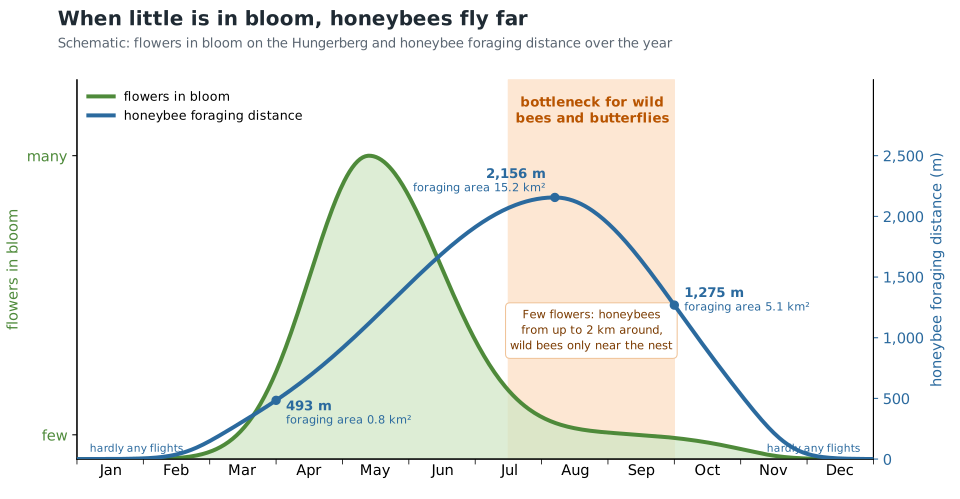
How to read the chart: The chart is a schematic, not a data series. The green curve shows how much is in bloom on the Hungerberg – without figures, just from few to many. It follows our own survey in the Böhnlöchle area: things start in February, from late April to early June orchards, hedges and lean meadows flower at the same time, from late June it declines, and from mid-July only a few species are still in bloom – bramble, willowherb, late meadow flowers and, in autumn, ivy. Specialist agencies also describe this collapse of flowering in high summer for southern Germany. The blue curve belongs to the right-hand axis: it shows how far honeybees fly on average to forage. The three dots are the measured values of the study in England; below each is the size of the area that the bees of one colony then search. In between the curve is smoothed; in winter the bees hardly fly. What you see: the two curves run against each other. When the flowering supply falls, the foraging distance rises – in the high summer marked in orange, few flowers and long flights coincide.
Why high summer of all times. In spring, when something is in bloom everywhere, honeybees stay close to the hive and there is enough for all. In high summer they come from an area almost twenty times as large to the same few flowers that wild bees near their nest depend on. Few flowers, long journeys for the honeybees, no way out for the wild bees: that is where competition is decided.
Flowers that give only pollen. Part of what blooms on the Hungerberg in spring is wind-pollinated: hazel, birch, beech, oak, pine, walnut and fir. They spread their pollen on the wind and offer no nectar. For honeybees the early pollen of hazel and birch matters, because the colony raises its first brood with it in February and March; in summer the fir sometimes provides honeydew. Most wild bees can do little with wind-pollinated plants. What counts for them is what offers nectar and pollen together – plentiful in spring, scarce in high summer.
What studies say about competition
The question has been studied for years, and the results are not uniform. Two large reviews have evaluated the literature: one found signs of competition in 53 per cent of studies, the other possible negative effects on wild bees in 64 per cent. The German conservation association NABU counts 21 of 29 European studies with negative effects. A study in Paris found fewer large solitary bees, bumblebees and beetles on flowers where many bee colonies were kept.
A review for the German-speaking countries by Gratzer and Brodschneider (2023) urges caution in reading this: many studies show correlations, not causes; that honeybees and wild bees share the same flowers – 45.5 per cent of pollen and nectar plants in one German study – is not yet proof of harm. Studies that find competition are also more easily published than those that find none. The evidence is clearest for bumblebees. And the bigger factor in the decline of wild bees is loss of habitat: of flowering areas and nesting sites.
Our conclusion: honeybees are not the main problem for wild bees. But where flowers are scarce and many colonies stand, they can be one – and that is above all a matter of high summer.
How many colonies can a landscape take?
There is no limit, only rules of thumb. In its 2024 position paper, NABU recommends that no more than three colonies per square kilometre stand in nature reserves and within a radius of two kilometres around them – counting all apiaries together. The two kilometres are thus a belt around the reserve in which the same limit applies.
For comparison, NABU gives two figures: on average, Germany already has 2.78 colonies per square kilometre today – just below the recommended limit. It estimates the original density of wild-living honeybees in Europe at 0.1 to 1 colony per square kilometre, a third to a thirtieth of that.
The recommendation applies to nature reserves. Landscape protection areas, bird protection areas and FFH areas are something else: they have their own conservation goals and usually less strict rules. There is one nature reserve on the Winterbach municipal area, the Hirschäcker south of the Rems; the two-kilometre zone around it extends over the village and the Rems valley to the lower slope of the Hungerberg. There is no nature reserve on the Hungerberg itself, but there is a bird protection area, a landscape protection area, natural monuments, protected biotopes and lean meadows – areas for which we consider the same caution appropriate. What matters is less the annual average than what is in bloom in high summer: a number of colonies that nobody notices in May can be too many in August.
Diseases
Honeybees and wild bees share not only flowers but also pathogens. A study in northern Switzerland (Maurer et al. 2024) found on average more than ten times higher viral loads in honeybees than in wild pollinators. Wild bees that shared many flowers with honeybees carried more viruses. Where the landscape had more pollinator-friendly habitat, wild pollinators were less often infected – because they then depended less on the same flowers. Detecting viruses is not yet harm; how much wild bees suffer from them is open for many species. But transmission is considered well documented as a risk. Healthy colonies are therefore also nature conservation.
And the butterflies?
For wild bees there are now many studies showing competition with honeybees. For butterflies this is not documented: in Paris, researchers found fewer large solitary bees, bumblebees and beetles on flowers where there were many bee colonies, but no difference for butterflies and hoverflies. Butterflies tend to suck thinner nectar than bees, so they use the same flowers only in part, and their bottleneck is usually the caterpillar's food plant. For butterflies displacement is not documented, but we will start to assess it.
Where wild bees nest on the Hungerberg and along the Rems
Flowers alone are not enough. A wild bee needs its nest and its flowers close together – within the few hundred metres it can fly. Three quarters of wild bee species nest in the ground, the rest in cavities above ground. On the Hungerberg and along the Rems there is both:
- Open, sunny ground. Sparsely vegetated spots on path edges and banks, trodden patches, breaking edges, sandy or loamy cuttings. Mining and furrow bees dig their tunnels here. The sunnier and drier, the better.
- Steep faces in sunken lanes and quarries. Vertical, bare loam and sandstone faces are used by species that dig horizontally into the wall. The sunken lanes on the Hungerberg and the former Stubensandstein quarry are such places. → Sunken lanes and quarries
- Dry-stone walls and stone ridges. Mason bees nest in the joints of the old vineyard walls, and the stones store warmth.
- Deadwood and old fruit trees. Small species use beetle holes in dead wood as ready-made tunnels; larger ones such as carpenter bees gnaw their own way into rotten wood. Orchards with old trees offer both.
- Pithy and hollow stems. Small carpenter bees and yellow-faced bees build their nests in dry bramble, elder and mullein stems. Leaving margins standing over winter lets this brood live.
Which places these are on the Hungerberg can be guessed from the history map: sunken lanes, natural monuments such as the quarry and the path banks, the old traces on the slope. Where exactly wild bees nest, we have not mapped. → History map with sunken lanes and natural monuments · → Forest or meadow?
What helps
The good news: what helps wild bees does not harm honeybees. More flowers in high summer relieve everyone.
For everyone with a meadow, a garden or a field margin:
- Mow lean meadows late and in sections, so that something is in bloom in high summer and part always stays standing.
- Encourage late flowers: viper's bugloss, wild carrot, knapweeds, bellflowers, wild marjoram, chicory – and let ivy flower in autumn.
- Leave open, sunny patches of ground, deadwood, old walls and dry stems standing over winter.
- Do not remove caterpillar food plants such as nettles and meadow herbs everywhere.
For beekeepers:
- Match the number of colonies to the flowers available in high summer, not in spring.
- Be cautious about placing colonies near natural monuments, lean meadows and other sensitive areas.
- Keep colonies healthy and watch them; this also protects wild pollinators.
- Create flowers yourself: anyone who keeps bees can provide flowers and nesting sites at and around the apiary.
What you know and value, you protect. Over time we want to observe for ourselves who flies to the last flowers of the Hungerberg in high summer – honeybees, wild bees, bumblebees, butterflies – and report what we see. → Wildlife and plants on the Rems
Frequently asked questions
Do honeybees crowd out wild bees?
Not everywhere and not always. Where plenty is in bloom, there is enough for all. Where flowers are scarce and many colonies stand, many studies show fewer wild bees and bumblebees on the flowers. The most important reason for the decline of wild bees remains the loss of flowering areas and nesting sites.
How far does a honeybee fly?
On average just under 500 metres in spring, more than two kilometres in high summer, just under 1,300 metres in autumn; individual bees fly much further. The less is in bloom, the further they fly.
How far does a wild bee fly?
Small species usually only a few hundred metres, large species up to about a kilometre. In one experiment, a mason bee built almost a quarter fewer brood cells with just 150 metres more to fly.
How many bee colonies are too many?
There is no fixed limit. NABU recommends at most three colonies per square kilometre for nature reserves and within a radius of two kilometres around them, all apiaries together. On average, Germany already has 2.78 colonies per square kilometre. What matters is what is in bloom in high summer.
Does keeping honeybees help wild bees?
No, honeybees are livestock and no help for wild bees. Anyone who wants to help wild bees provides flowers in summer and nesting sites: open ground, deadwood, stems and walls.
Do honeybees harm butterflies?
That is not documented. A study in Paris found no difference for butterflies where many bee colonies were kept. For butterflies the bottleneck is usually the caterpillar's food plant. We will start to assess this on the Hungerberg.
Where do wild bees nest?
Three quarters of the species in the ground, in open, sunny spots. The rest in deadwood, stems, wall joints and steep faces. Nest and flowers must be close together.
Sources
- Couvillon, Schürch & Ratnieks (2014): Waggle dance distances as integrative indicators of seasonal foraging challenges, PLoS ONE 9: e93495
- Zurbuchen et al. (2010): Long foraging distances impose high costs on offspring production in solitary bees, Journal of Animal Ecology 79; Zurbuchen et al. (2010): Maximum foraging ranges in solitary bees, Biological Conservation 143
- Gratzer & Brodschneider (2023): Die Konkurrenz von Honigbienen und Wildbienen im kritischen Kontext und Lektionen für den deutschsprachigen Raum, Entomologica Austriaca 30: 247–285 (including Mallinger et al. 2017, Iwasaki & Hogendoorn 2022)
- NABU: position paper on honeybees and wild bees, 07.03.2024 (German)
- LUBW: nature reserves and bird protection areas (based on data from the UIS of the LUBW, queried 03.10.2026), own analysis of the two-kilometre zone
- Ropars et al. (2019): Wild pollinator activity negatively related to honey bee colony densities in urban context, PLoS ONE 14: e0222316
- Maurer et al. (2024): Species traits, landscape quality and floral resource overlap with honeybees determine virus transmission in plant–pollinator networks, Nature Ecology & Evolution
- Kim, Gilet & Bush (2011): Optimal concentrations in nectar feeding, PNAS 108
- Westrich (2018): Die Wildbienen Deutschlands, Ulmer
- BUND: Wildbienen-Nisthilfe (three quarters of wild bees nest in the ground), accessed 03.10.2026
- Bavarian State Institute for Viticulture and Horticulture (LWG): Bienenweiden – flowering declines from late June
- Timberlake et al. (2019): Phenology of farmland floral resources reveals seasonal gaps in nectar availability for bumblebees, Journal of Applied Ecology 56
- Flowering calendar for the Böhnlöchle area: own survey
Last updated: 15 October 2026 · Initiative Remswelle