
Rems and Winterbach · River, water, nature and history
Wildlife and plants on the Rems
Barbel, kingfisher and water frog live on the Rems at Winterbach – these three are presented by the state agency for watercourses (Landesbetrieb Gewässer) on the information boards along the restored Rems. Since 2022 the beaver has been back there too. How well life in the river is doing overall is assessed under the EU Water Framework Directive: in the Rems the small organisms on the river bed and the aquatic plants are rated "good", the fish only "moderate". On this page we strictly separate what is documented for Winterbach, what is documented for other sections of the Rems and what only applies in general. A complete, official species list for Winterbach is not publicly available.
Many habitats in one river
"Die Rems bei Winterbach lässt sich der Barbenregion zuordnen" (the Rems at Winterbach can be assigned to the barbel zone), writes the Stuttgart Regional Council (Regierungspräsidium). The barbel is therefore the indicator fish of this stretch of river – and it shows what a river needs: it spawns at shallow, gravelly spots in flowing water, and its eggs stick between the gravel and under stones. The young fish first seek out calm areas and later move into flowing water. The kingfisher, by contrast, needs undisturbed steep banks free of vegetation, the water frog sunny banks and shallow water. What is valuable, then, is not one particular "ideal" Rems but many structures side by side: fast and slow water, gravel, deep spots, cover, shallow water and quiet banks.
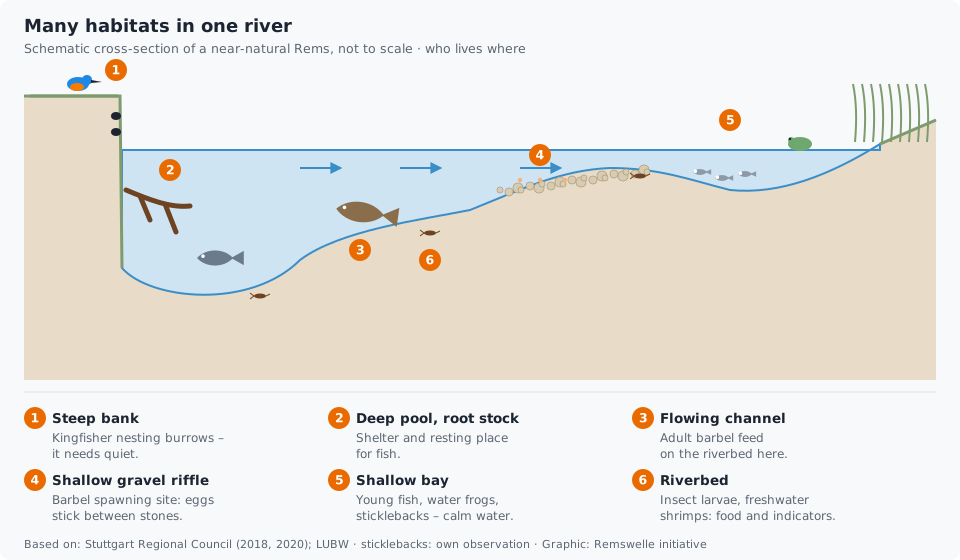
Documented near Winterbach
- Barbel – a bottom-dwelling fish of fast-flowing rivers that spawns on shallow gravel. Characteristic species on the information boards along the restored Rems.
- Kingfisher – breeds in steep banks without vegetation and is sensitive to disturbance; on the information boards, and observed at new nesting burrows shortly after the restoration.
- Water frog – the third characteristic species on the information boards.
- Beaver – clear signs since March 2022 between Winterbach and Remshalden, probably two animals in 2023; after the 2024 flood disappeared for a time, documented again since April 2025. → Restoration at Winterbach
From our own observation: around the Remsknie (bend of the Rems), at the small weir and at the Ostlandstraße bridge we regularly see large numbers of sticklebacks – small fish that like calm, shallow water. This is our observation, not an official record.
Documented on other sections of the Rems
- Common nase – a fish that depends on gravelly rivers; in April 2021 three dead nases were found near Plüderhausen, the cause remained unclear.
- Brown trout and bullhead – near Lorch-Waldhausen, according to the guides on river walks run by the local fishing and conservation club (2021). Some 35 species of dragonfly are also said to occur there, as well as kingfisher and dipper.
- Signal crayfish and muskrat – introduced species from North America, near Lorch; the signal crayfish displaces the native noble crayfish.
- Lower Rems valley between Waiblingen-Neustadt and Remseck: kingfisher, dipper, grey heron, grey wagtail, goosander, fire salamander and over 150 bird species in the nature reserve.
Angling portals list further species for the stretch near Schorndorf and Winterbach, such as chub, dace, pike and carp – all species that belong here according to the official reference list (see below). But these are user reports, not official records; we therefore do not list them as documented.
Problem plants on the banks
On the bank slopes near Lorch-Waldhausen, according to the river-walk guides, Himalayan balsam and Japanese knotweed are spreading strongly. Both plants come from Asia and displace native bank vegetation. For the Winterbach section we have found no published evidence of this.
How the Water Framework Directive rates the Rems
For management purposes the Rems is divided into two water bodies. The boundary lies at the mouth of the Walkersbach below Lorch. Above it the ecological status is "moderate", below it – with Schorndorf, Winterbach and Remshalden – "unsatisfactory". In both sections the small organisms on the river bed and the aquatic plants are "good", the fish "moderate". The rating is pulled down mainly by transverse structures, straightened sections and altered flow – that is, by the habitat rather than by water quality. Among the measures the state plans is making weirs and diversions between the mouth and the Walkersbach passable. → Water quality of the Rems
Which fish belong in the Rems at Winterbach
What does the Water Framework Directive measure the fish against? Against a list that the state's Fisheries Research Station has drawn up for every river section: the reference fish community. It describes which species would be expected, and in what proportions, in a near-natural state. For the Rems from the mouth of the Haldenbach at Weinstadt-Endersbach to the mouth of the Schornbach in Schorndorf – and so also for Winterbach – it comprises 27 species:
- Key species: barbel, common nase, chub, dace and gudgeon (9 per cent each), minnow, stone loach and spirlin (7.4 per cent each), eel and roach (6 per cent each).
- Accompanying species: perch and bleak (3.5 per cent each), brown trout, bullhead and pike (2 per cent each), grayling (1.6 per cent), carp (1 per cent).
- Rare species: common bream, three-spined stickleback, Prussian carp, burbot and souffia (0.8 per cent each), brook lamprey (0.4 per cent), white bream, crucian carp, rudd and tench (0.2 per cent each).
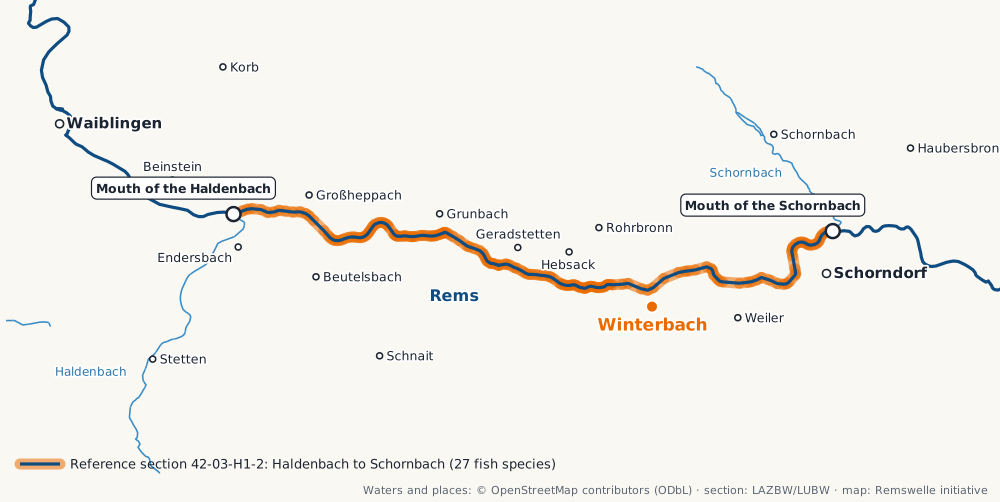
The list shows what belongs here – not what actually occurs today. But it fits what can be seen on the Rems: the barbel on the information boards is one of the key species, and the three-spined stickleback we observe at the Remsknie is on the list too. Bullhead, souffia and brook lamprey are specially protected under the European Habitats Directive. Barbel and nase migrate to their spawning grounds on gravel beds over the course of the year – one reason why weirs weigh so heavily in the assessment.
Along the river the picture changes: in the upper course as far as Schwäbisch Gmünd the Rems is dominated by trout and grayling, from Schwäbisch Gmünd to its mouth by carp-like fish (cyprinids) such as barbel, nase and chub. The official classification is "cyprinid-dominated water of the rhithral" – a river with still fairly cool, flowing water in which the cyprinids already set the tone.
The invisible life on the river bed
Countless small animals live on the river bed: larvae of mayflies, stoneflies and caddisflies, freshwater shrimps (amphipods), snails and mussels. Specialists call them macroinvertebrates (benthic macroinvertebrates, German: Makrozoobenthos). They are food for fish and birds and at the same time indicators of the condition of a river: because some species live only in clean, oxygen-rich water, their composition shows how polluted a watercourse is. The LUBW therefore uses them for the assessment – in the Rems they are rated "good". Exactly which species live near Winterbach has not been published.
Legally protected habitats (biotopes) around Winterbach
Around the Rems in Winterbach the state has mapped numerous areas as legally protected habitats (biotopes) – protected by law under nature conservation and forest legislation, even without a designated protected area of their own. Directly on the river these are above all the restored Rems floodplain west of Winterbach (about 3.9 hectares) and a strip of riparian woodland along the Rems north-east of Winterbach, right by the Remswehr (about 1 hectare). On the slopes there are also streamside woodland on the Krebsbach and Wattenbach, the ravines (Klingen) on the Altenberg and the Höffenklinge, the spring in the Pfaffenbronn area, dry-stone walls, field hedges and species-rich hay meadows.
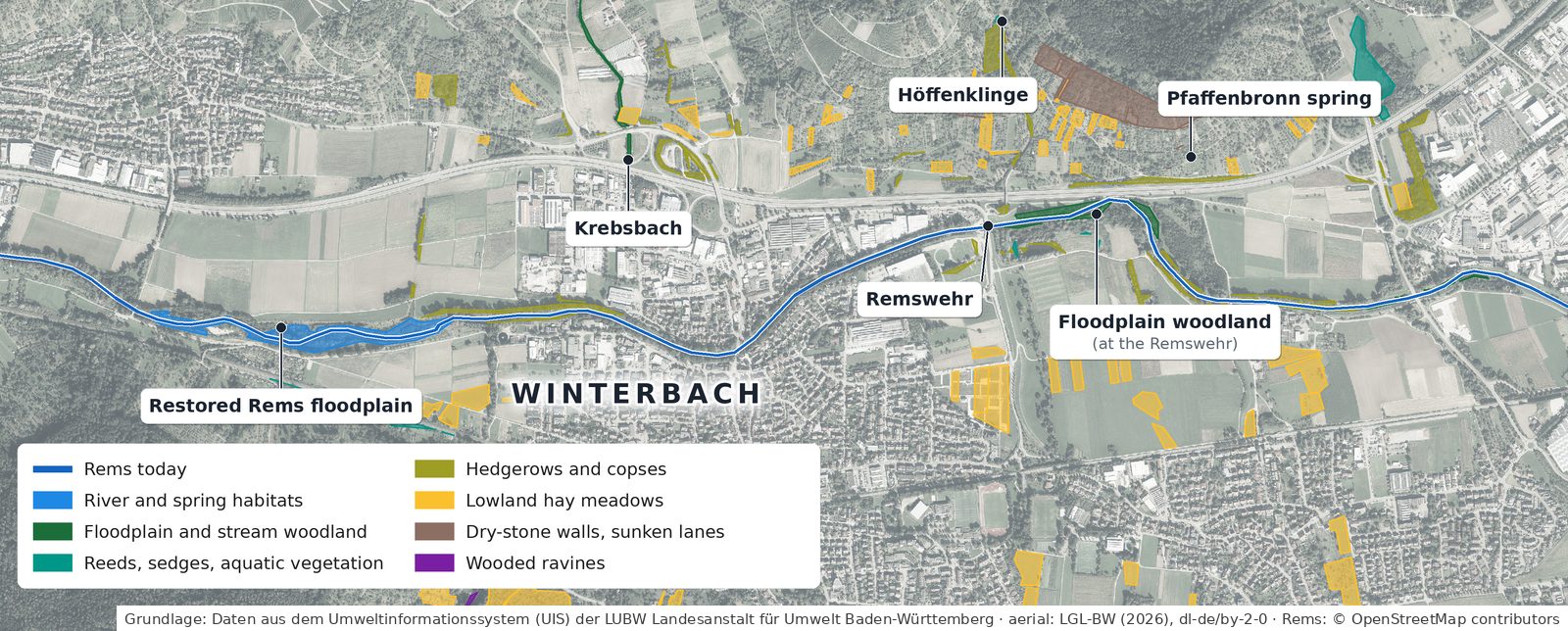
The map shows the areas as recorded in the LUBW biotope survey, simplified and without guarantee. We will publish descriptions of the individual biotopes once we have evaluated the reports.
Protected areas
On the Rems lie the FFH (Habitats Directive) site "Unteres Remstal und Backnanger Bucht" and the nature reserve "Unteres Remstal" – both downstream between Waiblingen and Remseck, not near Winterbach. About 15 per cent of the FFH site "Schurwald" lies in the municipal area of Winterbach, but it covers forest, ravines and streams, not the Rems. Above Winterbach lies the landscape conservation area "Remsaue mit Linsenberg" near Schorndorf and Urbach. As far as we know, the Rems at Winterbach itself does not lie in any FFH site, bird protection area or nature reserve; this can be confirmed in the LUBW map service.
Where the protected biotopes and protected areas around Winterbach lie is shown on the nature map – plus, if you like, the green belts of the regional plan.
From the Erlenbrunnen to the Rems: the Krebsbach
How closely the small streams are linked to the Rems is shown by the Krebsbach. It rises north-east of Rohrbronn in the Erlenklinge, a deeply incised wooded ravine that lies mostly in the municipal area of Remshalden and to a small extent in that of Winterbach. Its spring is captured in the Erlenbrunnen, a natural monument. The forest biotope survey of Baden-Württemberg lists the Erlenklinge as a protected biotope: a slow-flowing stream up to 1.5 metres wide with clear water that carries water all year round, with near-natural accompanying vegetation of black alder, ash and sycamore. In the 1990 survey yellow-bellied toad and fire salamander were recorded here, as well as grass snake, golden-ringed dragonfly and black woodpecker; in 2012 brooklime and common valerian were added. Directly next to it lies the biotope "Buchen-Altholz NO Rohrbronn" (old beech stand north-east of Rohrbronn) with hollow trees and deadwood – habitat for bats such as the greater mouse-eared bat and the common noctule, for stock dove and black woodpecker.
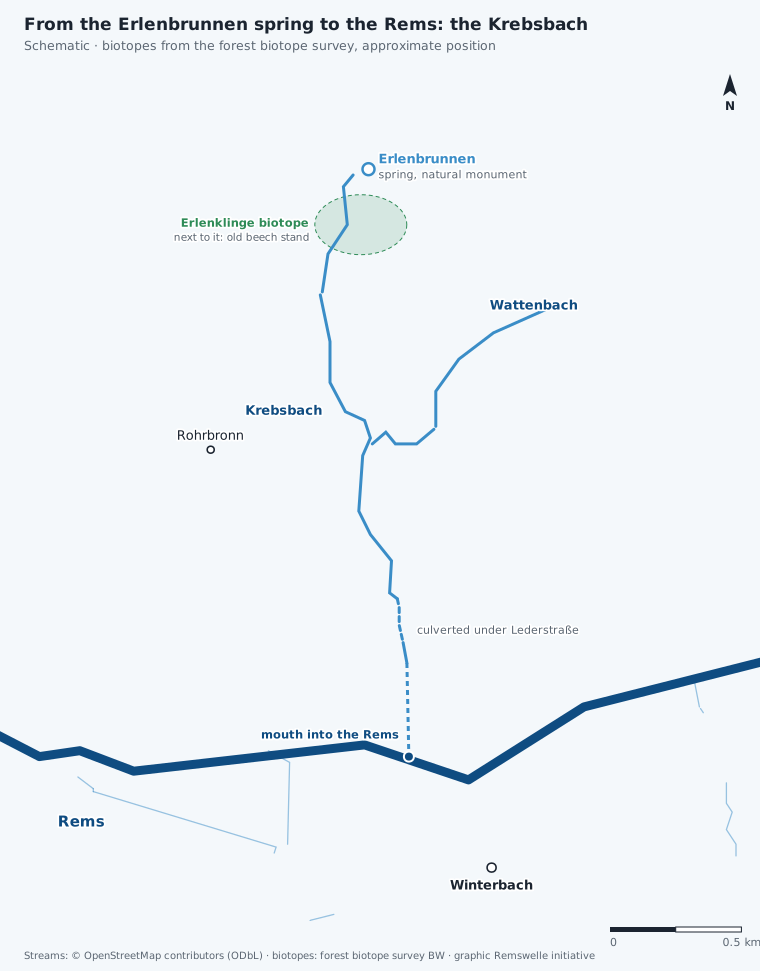
Below the ravine the Krebsbach flows south, takes in the Wattenbach from the east, reaches Winterbach, is culverted under Lederstraße and joins the Rems. What begins as a spring in the forest thus arrives in the river a few kilometres further on – and in heavy rain, as in June 2024, in the middle of the village too. Members of the initiative look after the forest edge, orchard meadow and lean meadow in the Bohnlöchle area as volunteers.
Wild bees, butterflies and honeybees
On the Hungerberg and at the edge of the Schurwald a great deal is in bloom in spring and early summer: blackthorn, orchard trees, hawthorn, elder and the lean meadows with their many species. From mid-July things get scarce. That is exactly when honeybees fly furthest and meet wild bees that can forage only a few hundred metres around their nest. We have devoted a page of its own to the question of whether honeybees crowd out wild bees – with foraging distances, flowers in bloom, the state of research, nesting sites on the Hungerberg and what helps. → Too many bees?
Experiencing and protecting the Rems
People protect what they know and value. At the Rems Clean-up we collect litter along the banks, and children are welcome. If you are out on the restored Rems, you help the animals most by staying on the paths, respecting the quiet zones on the right bank and keeping dogs on a lead. In 2020 the Regional Council created two access points to the water there and marked the areas that should not be entered with ropes and signs. → Join the clean-up · → Children and young people
What this means for the Remswelle
A wave must not make the Rems worse as a habitat. Fish passage is a condition, not a bargaining chip – precisely because the fish are already rated only "moderate" under the Water Framework Directive. Which species occur at the site and what a wave would mean for them must be clarified by the feasibility assessment; this includes a fish survey by specialists. The restoration offers a lesson: where people come to the water, there needs to be a clear separation between areas for people to spend time and quiet areas for the kingfisher and other wildlife. → Ecology and permits
Frequently asked questions
What is the barbel zone?
Rivers are divided into zones according to their typical indicator fish. The barbel zone covers medium-sized stretches of river with strong currents and a gravelly bed. The Stuttgart Regional Council (Regierungspräsidium) assigns the Rems at Winterbach to the barbel zone.
Which fish live in the Rems?
Documented species include barbel (near Winterbach), common nase (near Plüderhausen), brown trout and bullhead (near Lorch). A list of the species actually caught at Winterbach has not been published. What would be expected here is set out in the official reference fish community: 27 species, led by barbel, nase, chub, dace and gudgeon. We ourselves regularly see sticklebacks at the Remsknie and at the Ostlandstraße bridge.
Are there beavers on the Rems?
Yes. Between Winterbach and Remshalden beavers have been documented since March 2022; after the 2024 flood they disappeared for a time, and they have been back since April 2025.
Are there kingfishers in Winterbach?
Yes. The kingfisher is one of the three characteristic species on the restored Rems at Winterbach and breeds there in steep banks.
Does the Rems at Winterbach lie in a protected area?
As far as we know, no. The FFH site and the nature reserve "Unteres Remstal" lie downstream between Waiblingen and Remseck.
Where does the Krebsbach rise?
In the Erlenklinge north-east of Rohrbronn; the spring is captured in the Erlenbrunnen, a natural monument. The stream joins the Rems in Winterbach.
Sources: LUBW, Biotopkartierung (biotope survey; data from the LUBW environmental information system, queried 26.09.2026) · LUBW, assessment of macroinvertebrates (Makrozoobenthos) under the Water Framework Directive · Fisheries Research Station Baden-Württemberg (LAZBW), Referenz-Fischzönosen für Baden-Württemberg (reference fish communities), as of July 2023, reference 42-03-H1-2 · LUBW, map service "Fischgemeinschaft" (fish community types under the Surface Waters Ordinance, as of May 2019) · Remswelle initiative, own observation (sticklebacks) · Regierungspräsidium Stuttgart, Landesbetrieb Gewässer: "Neue Beschilderung für mehr Rücksicht auf die Natur an der Rems in Winterbach", 18.12.2020; "Die Rems fließt wieder", 19.12.2018; Begleitdokumentation Teilbearbeitungsgebiet 42 zum Bewirtschaftungsplan 2022–2027 (supporting documentation for sub-basin 42 of the 2022–2027 management plan), as of December 2021 · Waldbiotopkartierung Baden-Württemberg (forest biotope survey), biotopes 271221192164 "Erlenklinge NO Rohrbronn" and 271221192165 "Buchen-Altholz NO Rohrbronn" (recorded 1990, revised 20.11.2012) · Zeitungsverlag Waiblingen: beaver signs (March 2022), 08.03.2023, April 2025; dead fish near Plüderhausen, 20.04.2021 · Gmünder Tagespost, 31.03. and 01.04.2021 (river walk Lorch-Waldhausen) · Regierungspräsidium Stuttgart, leaflet on the nature reserve "Unteres Remstal" (2013) · Wikipedia, "Liste der Zuflüsse der Rems" (Krebsbach) and lists of landscape conservation areas and FFH sites (accessed 26.09.2026)
Last updated: 15 October 2026 · Initiative Remswelle