
Rems and Winterbach · River, water, nature and history
The Rems is getting warmer
Climate change is usually discussed in terms of hot days, drought or heavy rain. It is less well known that our rivers are warming too. On the Rems this can be traced precisely: the State Institute for the Environment of Baden-Württemberg (LUBW) has measured the water temperature at Waiblingen-Neustadt every day since 1981 – downstream of Winterbach, in the same stretch of river. We have analysed the series.
What the measurements show
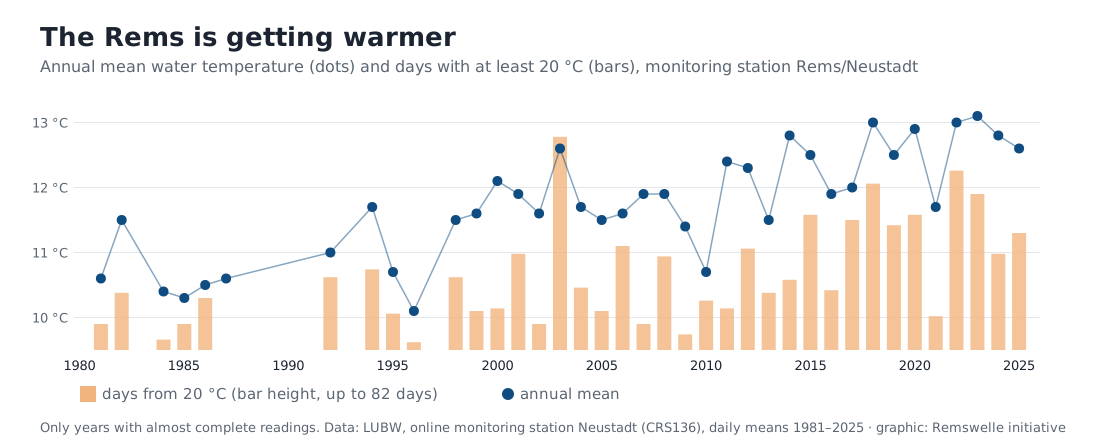
- The annual mean has risen by about 2 °C: from about 10.7 °C in the 1980s to about 12.6 °C on average in 2016 to 2025. Over the whole series that is about 0.5 °C per decade.
- Even more in summer: the June-to-August mean rose from about 17.1 °C in the 1980s to about 19.6 °C in the last ten years – about 2.5 °C more.
- Four times as many warm days: days with a water temperature of at least 20 °C occurred a good ten times a year in the 1980s and more than 40 times on average in the last ten years. The record was the hot summer of 2003 with 82 days.
- A new record in 2026: on 27 June 2026 the daily mean was 25.4 °C – the highest value since the series began. For the first time, daily means exceeded 25 °C, and with about 21 °C on average from June to August, summer 2026 was the warmest after 2003.
The Rems is thus in line with what the federal states have found across the region in the KLIWA cooperation project: at 45 of 78 monitoring stations in Baden-Württemberg and Bavaria, the water temperature has risen significantly, by about 0.2 to 0.7 °C per decade.
Why a river warms up
River water takes on the temperature of its surroundings: warmer air, more hours of sunshine and longer heatwaves warm it directly. In addition, the Rems often carries little water in summer – and a small volume of water warms up faster. Where there are no trees along the banks, the sun shines unhindered on the water. Discharges, such as treated wastewater from sewage plants, and impoundment can also play a role; the KLIWA analysis explicitly points out that the measured trends also reflect such uses.
What this means for fish and small animals – our assessment
Less oxygen, greater demand. Warm water can hold less oxygen: at 15 °C, full saturation is about 10.1 milligrams per litre, at 25 °C only about 8.3. At the same time, fish, small animals and bacteria need more oxygen in the warmth – as a rule of thumb, biological activity doubles with every 10 °C. Together, this makes hot summer days with little water a critical time for life in the river.
A guide value is exceeded more often. For good ecological status, the German Surface Waters Ordinance (OGewV) sets a maximum summer temperature for each fish community. For the fish community of the Rems at Winterbach and Waiblingen (cyprinid community of the rhithral) it is 23 °C. Daily means above 23 °C were hardly ever measured on the Rems in the 1980s and 1990s; there were 12 days in 2003, 11 in 2015, 10 in 2018, 9 in 2019 – and already 17 in 2026. Because these are daily means, the afternoon peaks were even higher.
Winners and losers. The Rems at Winterbach belongs to the barbel zone. The typical fish community that the state fisheries research centre describes for this stretch consists mainly of barbel, nase, chub, dace and gudgeon – species that tolerate warm summer water. But the reference also includes cold-water species such as brown trout, bullhead and grayling, each at a few per cent. They need cool, oxygen-rich water; the bullhead is considered a distinctly cold-water species. Our assessment: if the trend continues, these species will have a harder time in the lower and middle Rems, while warmth-loving species will benefit. The fish zones are, in a sense, shifting upstream. The same applies to small animals on the river bed: stonefly and some mayfly larvae need cool, oxygen-rich water. → Wildlife and plants
A look ahead. If warming of about 0.5 °C per decade continues, the annual mean of the Rems would be about 14 °C by the mid-2050s and the summer mean about 21 to 22 °C – summers like 2003 or 2026 would then no longer be the exception. This is a simple extrapolation, not a climate projection.
What helps: shade
The most effective measure against the warming of small and medium-sized rivers is shade. According to the KLIWA brief report "2-degree target for our streams", well-shading bank vegetation can lower the daytime temperature of narrow streams in high summer by about 5.5 to 7 °C, and in ten-metre-wide rivers with tall trees still by about 4 to 5.5 °C. KLIWA therefore recommends planting more site-appropriate bank vegetation – it could offset the expected temperature rise of the next 30 years in many waters. Along the restored Rems in Winterbach such trees and shrubs are growing up right now. → Restoration of the Rems in Winterbach
A conflict of aims: trees and embankments. Shade needs trees – but on and close to flood embankments, trees and shrubs are not wanted under the technical standard DIN 19712. Falling trees can tear root craters several metres across, roots can create seepage paths, and dead roots leave cavities. The Karlsruhe regional council gives a minimum distance of 10 metres from the foot of the embankment, 30 metres for poplars. Shade and flood protection therefore have to be planned together: trees belong where the bank is not also an embankment – for example in restored sections with a wide floodplain.
What this means for the Remswelle
A wave adds no water to the Rems and takes none out; in our assessment it makes no significant difference to the temperature of the river. Still, the warming matters to us: trees and bank vegetation at the site should be preserved, and fish passage is a condition for us anyway. And in high summer, when the Rems is warm and low, the wave will usually not run anyway because there is too little water. → Questions and objections
Frequently asked questions
How much has the Rems warmed?
At the Waiblingen-Neustadt station the annual mean rose from about 10.7 °C (1980s) to about 12.6 °C (2016–2025), in summer from about 17.1 °C to about 19.6 °C. That is about 0.5 °C per decade.
How warm was the Rems in 2026?
On 27 June 2026 the daily mean reached 25.4 °C, the highest value since 1981. Summer 2026 averaged about 21 °C.
Why is warm water a problem for fish?
Warm water holds less oxygen, while fish need more of it in the warmth. Cold-water species such as brown trout, bullhead and grayling come under pressure first.
What can be done about the warming?
Above all, create shade: trees and shrubs on the banks can lower the water temperature in summer by several degrees. More water in the river (fewer abstractions) and near-natural banks also help.
Sources: LUBW Landesanstalt für Umwelt Baden-Württemberg, online monitoring station Neustadt (CRS136), Rems, water temperature daily means 1981–2026, Daten- und Kartendienst der LUBW, accessed 28.09.2026 – own analysis (annual means only for years with at least 330 days of readings) · KLIWA, "Wassertemperatur – Langzeitverhalten" (www.kliwa.de) · KLIWA brief report "2-Grad-Ziel für unsere Bäche – Wassertemperatur und Beschattung" · Oberflächengewässerverordnung (OGewV), Annex 7, no. 2.1.1 · LAZBW Fischereiforschungsstelle, reference fish communities Baden-Württemberg, reference 42-03-H1-2 (as of July 2023) · R. Reinartz, "Auswirkungen der Gewässererwärmung auf die Physiologie und Ökologie der Süßwasserfische Bayerns", literature study for the Bavarian Environment Agency, 2007 · Regierungspräsidium Karlsruhe, FAQ on trees and shrubs at flood embankments (DIN 19712), as of August 2019 · Oxygen solubility: standard physical values for fresh water at normal pressure
Last updated: 15 October 2026 · Initiative Remswelle