
River waves · building, running, surfing
Where rivers become surfable by themselves
Most river waves we write about on these pages are built – from the Eisbach to the Leinewelle. But they also exist without any structure: rivers that throw surfable waves of their own accord. Sorting them helps you understand the physics of every river wave along the way. Three kinds can be distinguished.
Kind 1: travelling tidal bores
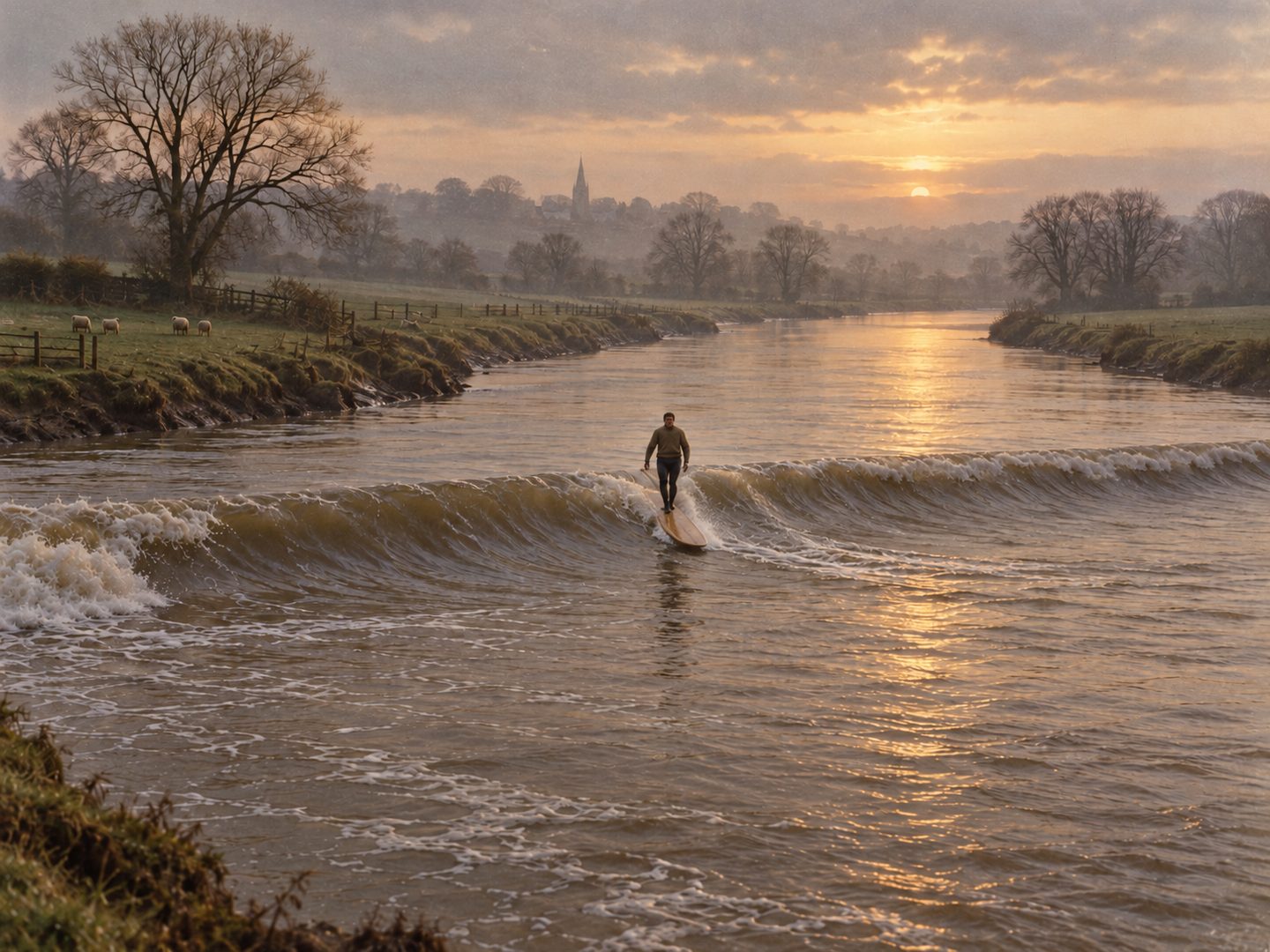
Where a large tidal range meets a funnel-shaped river mouth, the flood tide pushes a wave upstream – a tidal bore. The wave travels, and whoever catches it rides for kilometres.
- Severn (England): Europe's most famous bore, around two metres high in good conditions. In 1955 a British officer rode it on a home-built board – according to the Museum of British Surfing, thought to be the world's first documented ride on a river tidal wave.
- Bono on the Kampar (Indonesia): forms whole trains of waves; some of the longest river rides ever documented happened there.
- Pororoca (Brazil): the Atlantic tide pushes into channels of the Amazon region – long rides, considerable risks from driftwood and current.
- Mascaret of the Dordogne (France): the most accessible European bore besides the Severn, with an established surf scene at Saint-Pardon.
- Qiantang "Silver Dragon" (China): one of the world's largest bores, documented for centuries, surfed at organised events.
- Turnagain Arm (Alaska): long rides in the cold water of a sea arm.
Add the Petitcodiac (Canada), the Garonne (France), the Trent (England) or the Benak on the Batang Lupar (Malaysia). A borderline case is Skookumchuck Narrows (Canada): there the tidal current pushes through a sea strait and creates a stationary wave – tidal drive, standing form.
Kind 2: waves from released water
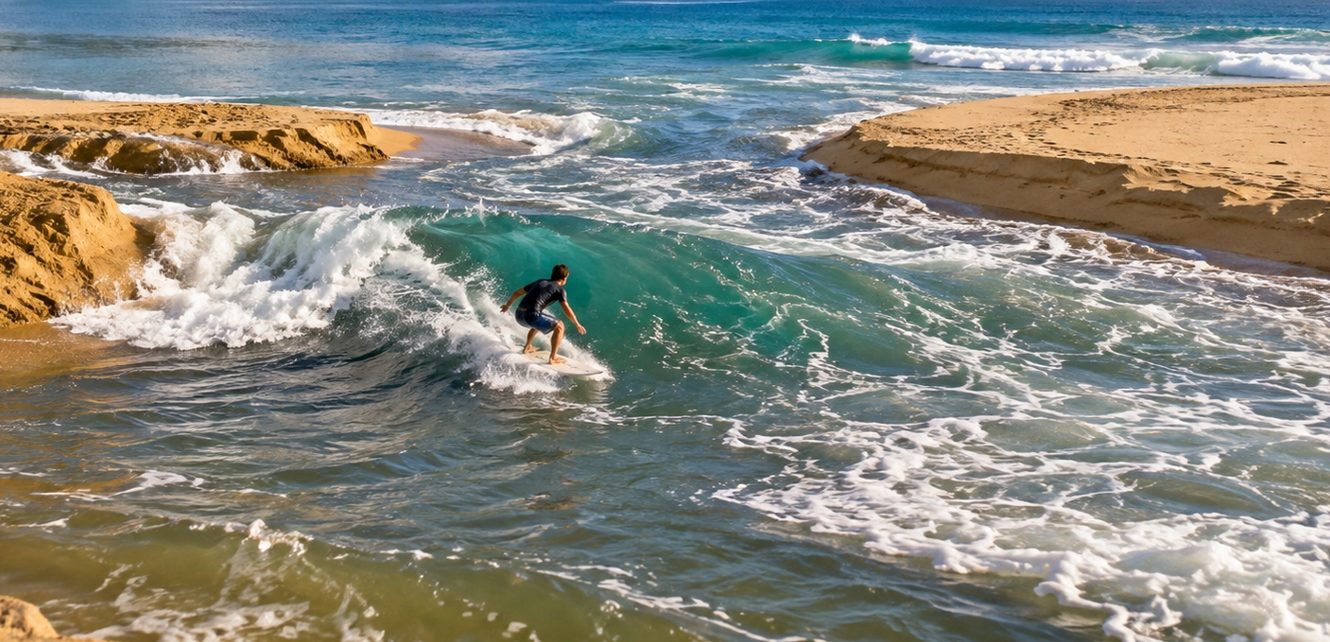
Rarer, and for our own search the most interesting kind: water is held back and released, and the raised flow shapes a surfable wave.
- Waimea River (Hawaii): at the river mouth, water periodically backs up behind a sand bar. When the bar is opened, the flow shoots towards the sea and can form a temporarily standing, surfable wave over the sand – the best-known example of the principle "open the retention, surf the wave".
- Lunch Counter on the Snake River (Wyoming): a natural standing wave at a rapid whose quality also depends on releases from a dam upstream – here the release strengthens an existing wave rather than creating one.
The parallel to the historical timber drift on the Rems is obvious: there too, water was collected and released – only for firewood rather than for surfers. Whether surfable waves ever formed is not documented; the Waimea merely shows that the principle can throw waves. → The forgotten wave of Winterbach Important: for a classic reservoir whose release itself creates a surfable front travelling downstream, we know of no documented surf example – and surge operation is no concept for the Remswelle in any case.
Kind 3: natural standing waves
The third kind is the relative of every built river wave: current meets rocks, sills or bed forms, and a stationary hydraulic jump forms. → How a standing wave forms
- Habitat 67, Montréal (Canada): North America's best-known standing river wave, in the St Lawrence; surfed since the early 2000s. The wave landscape is partly shaped by earlier construction in the river – even this one is not entirely "untouched".
- Vague à Guy, Montréal: at the Lachine rapids; the city officially lists the spot for surfing, kayaking and stand-up paddling.
- Rapid #11 on the Zambezi (Zambia/Zimbabwe): a partly hollow-breaking standing wave below the Victoria Falls – seasonal, demanding, dangerous.
- Pipeline on the Lochsa River (Idaho): a standing wave in a largely free-flowing whitewater river, with no ramp at all.
- Lunch Counter on the Snake River: see above – depending on your reading, a natural wave with a regulation influence.
What we learn from this for the Rems
First: the energy source (tide, release, river current) and the wave form (travelling, standing) are two different things – the Skookumchuck proves it. Second: constrictions, bed shape and downstream level matter at least as much as the volume of water; which is exactly why the build of the historical Winterbach rafting chute interests us. → The riddle of the rafting chute Third: a wave can be part of a landscape and its culture long before anyone uses it for sport – the Severn was a natural spectacle for centuries before someone rode it in 1955. Perhaps one day the same will hold in reverse for the Rems: first the idea, then the wave.
All built waves in the German-speaking countries – with map, status and sources – are collected in our directory: → All river waves in the DACH region
Frequently asked questions
Can you just go and surf these natural waves?
No. Tidal bores run through mud, driftwood and shipping; whitewater waves sit in rapids with hydraulics and rocks. All the spots named demand experience, local knowledge and in some cases permits or an event setting. This page is an overview, not a guide.
Are there surfable natural waves in Germany?
Our rivers lack tidal bores, and genuine natural standing waves of surfable quality are not documented – the German river waves are built or structurally influenced waves. The directory shows the current state. → All river waves in the DACH region
Why is the Waimea not held up as a model for the Remswelle?
Because the Remswelle is meant to work differently: as a standing wave in the natural discharge of the Rems, without collected and surge-released water. The Waimea illustrates a historical principle – that of the timber drift – not our plan. → More flow for the Rems
Sources: Museum of British Surfing: timeline (Severn 1955) · National Tidal and Sea Level Facility: tidal river bores · Ville de Montréal: Vague à Guy / Lachine rapids · Reports and spot descriptions on the Bono, Pororoca, Qiantang, Turnagain Arm, Waimea, Lunch Counter, Zambezi Rapid #11 and Lochsa (surf and travel documentation; individual references with the spots once added to the directory) · → How a standing wave forms
Last updated: 15 October 2026 · Initiative Remswelle