
River waves · building, running, surfing
How to surf a river wave
Water, drive, weight
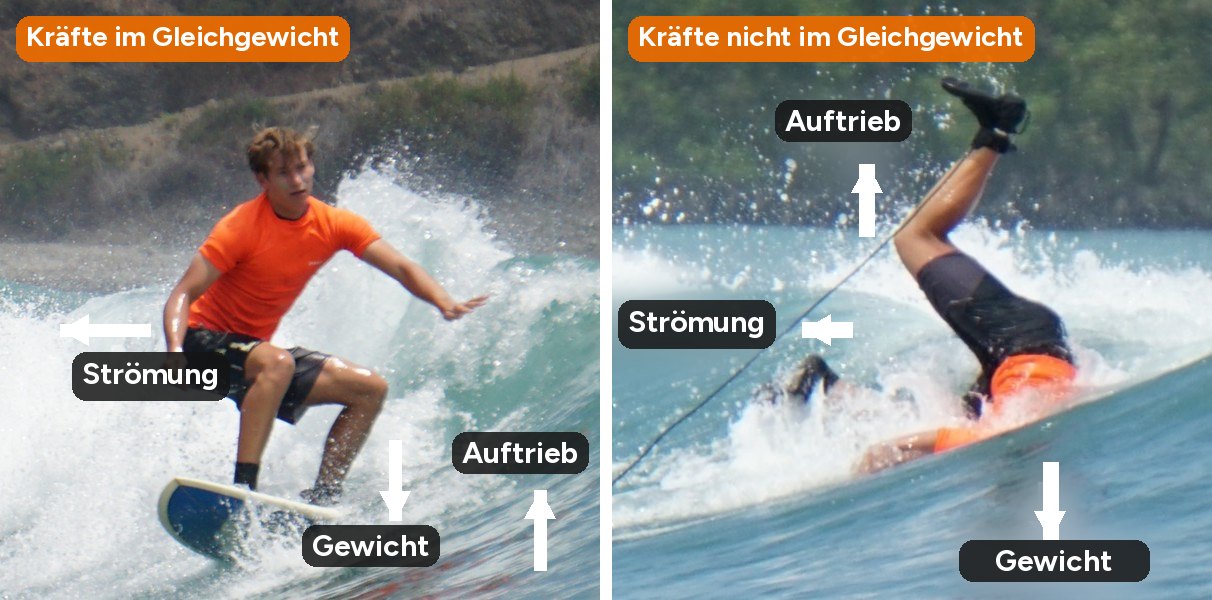
In the sea the wave pushes you. In a river nothing pushes you – the water flows towards you, and you stand on it like a kite in the wind. Three forces have to balance: the current, which pushes the board backwards, the buoyancy of the water, which carries it, and your weight, with which you press the board into the face of the wave. If the balance is right, flow sets in: you stand without moving, and the wave rushes through beneath you. If it is not right, you go into the water – downstream, into the calm run-out pool.
Getting on
At built waves you get on from the bank: lay the board on the face of the wave, hold on, lie down on it or step straight onto it. Beginner courses are available in Nuremberg, Hanover and Pforzheim; the Fuchslochwelle offers beginner sessions from May to September. You spend the first hours lying and kneeling until you have a feel for the current. You can also practise on land: on a surfskate in a pump track you train pumping, the basic movement of surfing. → Practising surfing on land
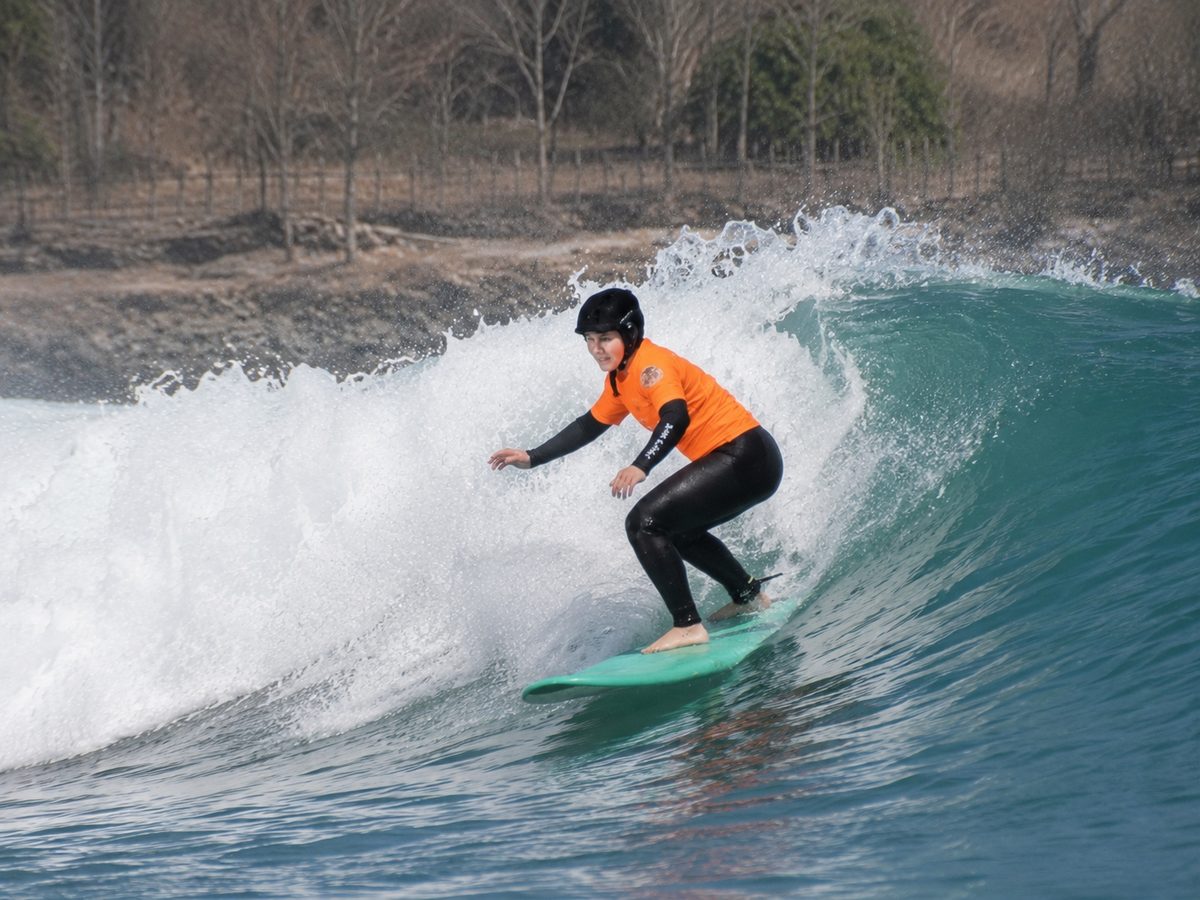
What does it feel like? On a river wave you do not travel forwards: you stay almost on the spot while the water rushes beneath you. You are carried by the pressure of the water against the slightly angled board and steer with the edge and your weight. That is like snowboarding in deep powder – there, too, the board floats and you steer with weight and edge. It has less in common with skateboarding on tarmac, where you roll on firm ground. Only pumping – gaining speed from the knees – can be practised well on a surfskate.
Equipment
River boards are shorter and thicker than ocean boards and have a soft nose. Neoprene all year round, a helmet is compulsory at almost all built waves – you are surfing close to concrete. A leash only where the operator allows it; in flowing water it can get caught.
With or without fins? Fins are the small blades under the tail. Like a keel, they keep the board on track and give grip in turns. River boards usually have two small fins, sometimes with a very small third one in the middle; for beginners soft, inexpensive fins are an advantage, because at some waves the board hits walls. Small fins make the board more manoeuvrable but less stable. It works without fins too: the old Hawaiian wooden boards, the alaia, had none – they were held only by their sharp edges. Skimboards still ride without fins today, and bodyboarders wear their fins on their feet instead of on the board. → Surfing without a wave
Safety
Standing waves are predictable, but flowing waters are not always. Rules at built waves: surfing hours, one at a time, no obstacles in the run-out zone, shutdown during floods. River surfing knows no age – but you have to be able to swim. What surfing can offer children and young people and what research says about it: → Surfing, young people and health Why the leash is the decisive safety question in a river and which rules the waves have for it: → Leash and safety How to practise on land – with surfskate, pump track, wing and sail: → Surfing without a wave
Frequently asked questions
Can you learn river surfing as a beginner?
Yes, on supervised waves with courses – Nuremberg offers children's courses from the age of twelve, Thun basic courses from 16. Getting started usually works faster than in the sea, because the wave always stands in the same place and you can repeat attempts in quick succession.
Which board do you need for a river wave?
Short, wide boards with a lot of buoyancy in relation to their length, usually between 5 and 6 feet. Supervised waves like Nuremberg or Pforzheim have rental equipment; at the Eisbach the scene has put together its own equipment since the 1970s.
Do you need a leash?
On river waves the leash is controversial, because it can get caught on stones and built-in structures. Pforzheim bans it, Thun advises against it, Munich has allowed only leashes that release under load since 2026. On supervised installations the operator's rules apply, usually together with compulsory helmets and vests.
Sources: Blue Tomato, "How to surf river waves" (fins on river boards) · Wikipedia, "Alaia" and "Surfboard fin"
Last updated: 15 October 2026 · Initiative Remswelle