
River waves · building, running, surfing
What a river wave costs – and who pays for it
The honest answer first: between a few hundred thousand and a few million euros, depending on site, construction type and procedure. The second honest answer: almost every wave in Germany was funded differently.
What real waves have cost
| Wave | Costs | Funding | Note |
|---|---|---|---|
| Fuchslochwelle Nuremberg (2022) | approx. €3 million | half from the Free State of Bavaria, plus city, sports funding, donations, sponsors | channel parallel to the Pegnitz, fish pass, adjustable modules |
| Leinewelle Hanover (2023) | €2.5 million | no public funds; €2 million in donations over ten years; sponsors enercity, Sparkasse, Gundlach | three steel wave bodies, hydraulically adjustable |
| blackforestwave Pforzheim (2021) | not published | main industrial sponsors (ADMEDES & G.RAU), municipal utilities, volunteers; conversion 2026 via crowdfunding | installation in an existing channel, 30 volunteers at the installation |
| Surfwelle Wolfratshausen (plan 2017) | approx. €360,000 planned | €200,000 EU, €100,000 city, €60,000 donations | ended by the town council in 2022: cost increases due to the pandemic and the Ukraine crisis |
| Neckarwelle Stuttgart (plan) | approx. €5 million (press) | intended: city | not approved in 2019 (water quality) |
The range is explained by the site: an installation in an existing channel or at an existing weir is cheaper than a new channel with a fish pass. Adjustable technology costs more than a fixed ramp, but yields more surf days and eases permitting.
What costs are made up of
Feasibility study and hydraulic modelling · survey (laser scan, echo sounder) · planning and permit documents · expert reports (ecology, floods, water quality if required) · construction: earthworks and concrete works, steel construction, hydraulics, controls · banks, entry and exit, safety · operation: insurance, maintenance, electricity for the controls, voluntary work.
Wolfratshausen shows the risk: between planning and construction, building prices can run away. A buffer of 20 to 30 per cent is not caution but experience.
What the Remswelle can learn from Wolfratshausen
The surf wave on the Loisach was approved and funded in 2017: around €360,000, of which €200,000 was EU funding, plus the town and donations. Five years later, on 28 June 2022, the town council ended the project unanimously – the costs had risen so much because of the pandemic and the Ukraine crisis that the funding no longer held up, after nine years of development. Nuremberg tells the same story with a good outcome: from €500,000 in the first estimate to around €3 million, because in the course of the procedure a ramp became a hydraulic structure with a channel, two weirs and a fish pass. Three lessons: a cost estimate is only robust once the permit planning is in place. Funding with a deadline is a risk if the procedure drags on – whoever has the approval must be able to build. And the less has to be newly built, the smaller the lever for cost increases; the fact that weir, banks and access already exist in Winterbach is therefore not only a cost argument but also a risk argument. → Case study Fuchslochwelle
Who pays?
The state. Bavaria paid half of Nuremberg – a political decision that does not yet exist in Baden-Württemberg for a river wave. The Remswelle could become the first example. The sports policy argument for it is stronger than many think: surfing has been an Olympic sport since 2021, the German Surfing Federation (DWV) is a member of the German Olympic Sports Confederation (DOSB), and Rapid Surfing on standing waves has had German Championships since 2019 – in 2026 as part of "Die Finals" in Hanover, live on ZDF. For wave sports there are practically no training venues inland; river waves are what canoe slalom courses are for canoeing. Possible routes in Baden-Württemberg:
- Tourism Infrastructure Programme (TIP) of the state of Baden-Württemberg's Ministry of Economic Affairs: application by the municipality, up to 30% of eligible costs (in special cases up to 60%), a maximum of €2.5 million per project, application by 1 October of the previous year to the Regional Council (Regierungspräsidium). Public leisure infrastructure and infrastructure that extends the season are eligible – whether a river wave falls under this is decided by the Regional Council case by case.
- Municipal sports facility funding (Regional Councils): traditionally for halls and outdoor sports facilities; application by 31 December of the previous year.
The municipality. The municipality is involved in almost all waves: as applicant for funding, as owner of the banks, often with a grant. Without the municipality it does not work.
Sponsors and donations. Hanover has shown that €2.5 million is possible entirely without public funds – with an energy supplier as name sponsor, the Sparkasse and a construction company, and with ten years of patience. Pforzheim lives on industrial sponsors and volunteers. Crowdfunding carries conversions and equipment, rarely the basic structure.
Volunteers. In Pforzheim, 30 club members installed the wave in three days. In Nuremberg, around 60 volunteers carry the operation. Voluntary work does not replace money, but it lowers the costs and convinces funders.
What this means for the Remswelle
As long as feasibility has not been established, there is no serious figure. What can be said today: in Winterbach the infrastructure is already largely in place. The outlet structure of the flood retention basin (locally called the "Remswehr") is there; the banks are reinforced, access and stepping stones exist. No channel has to be dug – one of the most expensive items of the comparison projects is thus eliminated. The effort is concentrated on what makes up the wave itself: an installation that creates the necessary head and shapes the wave – there is no step today –, possibly an adjustable ramp, entry and exit, safety. That makes Winterbach an economically interesting opportunity: most wave projects first have to create their infrastructure – here essential infrastructure is in place. How much this reduces the total cost, and where in the range the Remswelle ends up, only the feasibility assessment will tell – and the route via the municipality to the Tourism Infrastructure Programme is the one we are examining first.
The structure is there – now it is about its use
The weir under the Ostlandstraße bridge is no accidental structure. It is the outlet structure of the Schorndorf/Winterbach flood retention basin, which the Rems Water Board (Wasserverband Rems) – an association of twelve towns and municipalities from Essingen to Remseck, both districts and the state – built from 2002 to 2005: around €14.3 million, 1.17 million cubic metres of storage volume, in operation since October 2005 as the Board's first basin. The bridge is at the same time the embankment; during a flood the gates are closed here. It was paid for by the citizens of the Rems valley and the state, via the Board's levy and taxes. It is a "green" basin: normally empty, impounded only during floods – on almost every day of the year the Rems flows straight through the open structure.
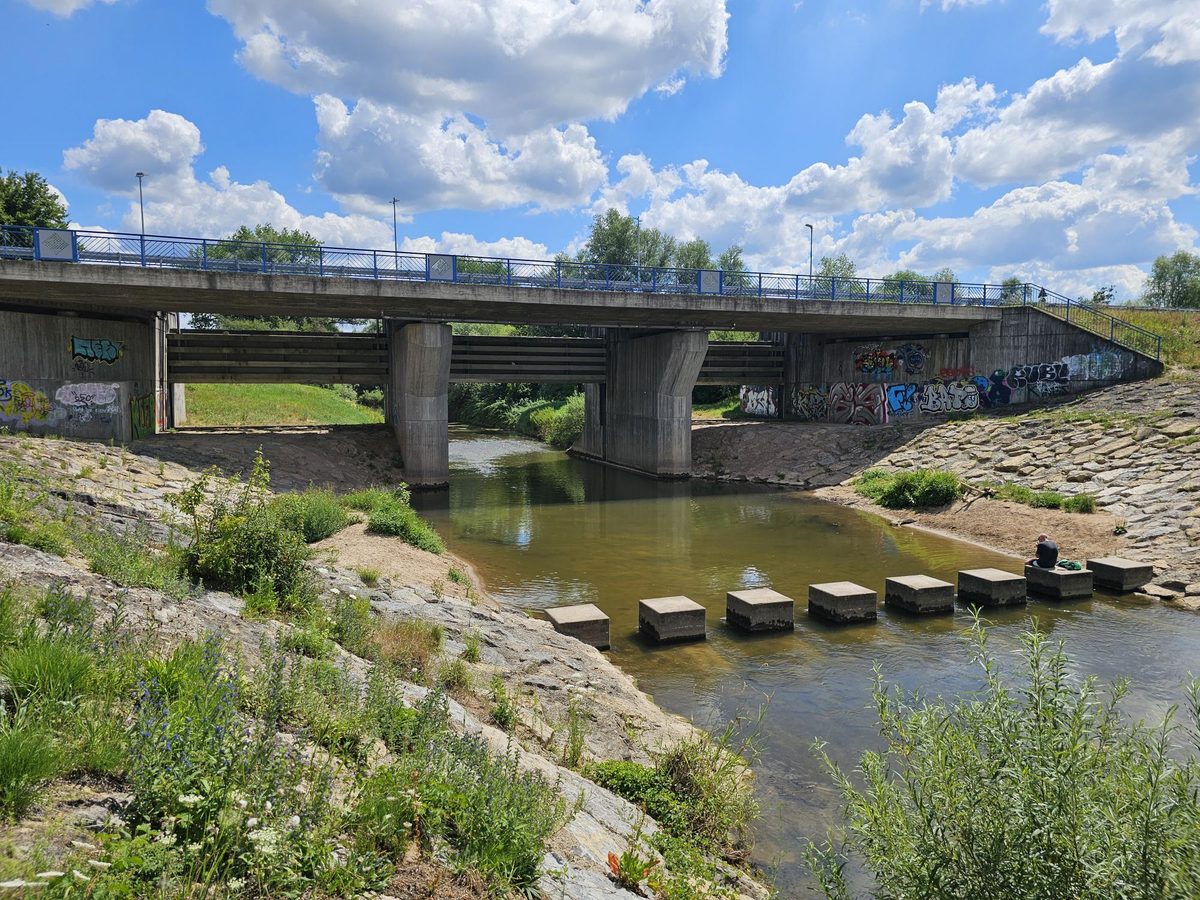
Our view: if a public structure can be put to sensible multiple use without impairing its main task, that creates additional benefit for everyone. Impairing flood protection is out of the question – that is a precondition of any planning. But outside the few flood days, the same structure could carry a place for sport, exercise and meeting. Those who paid for it should have a say. That is why we are seeking talks with the Rems Water Board, the district office (Landratsamt) as water-law authority and the Regional Council (Regierungspräsidium) – that is where responsibility for the structure lies.
What the Rems valley affords itself – and why a wave belongs to it
For the Remstal Garden Show 2019, sixteen municipalities each built themselves a landmark, the architecture project "16 Stationen" (16 Stations). Winterbach's contribution is the Monopteros on the Engelberg panorama trail – according to the municipality "good for views and insights, for dreamers and stargazers – and for beauty". €70,000 per station was planned, borne half by the municipality and half by the region; for the Monopteros the expected costs after a redesign were €140,000 to €150,000, of which €70,000 to €75,000 was the municipality's share. We think the series can be continued – for views and insights, for dreamers and stargazers, and also for movement and joy. A river wave is a landmark that people use: daily, over decades, by people from the whole region. It costs more than a station – the comparison projects above show the order of magnitude – but it is also more: sports venue, meeting place and emblem at the same time. Munich's tourist office lists the Eisbach wave as "one of Munich's top attractions", and Hanover's Lord Mayor spoke of the "surf city of Hanover" after Die Finals 2026. For the Rems valley, the wave would be what landmarks are meant to be: a reason to come here.
Frequently asked questions
How much does a river wave cost?
Between a few tens of thousands and a few million euros. Pforzheim (ramp in an existing channel) around €80,000 plus own labour, Salzburg €90,000, Augsburg around €350,000, Hanover €2.4 to 2.5 million, Nuremberg around €3 million with its own channel and fish pass. What matters is how much infrastructure is already in place.
Is there funding for a river wave in Baden-Württemberg?
There is no dedicated programme. Candidates are the state's Tourism Infrastructure Programme (application by the municipality, up to 30 per cent) and municipal sports facility funding; whether a wave is eligible is decided by the Regional Council (Regierungspräsidium) case by case. Bavaria paid half of Nuremberg and a good third of Augsburg.
Who pays for the running operation?
At all German waves, the operating club – through membership fees, slot fees, sponsors and donations. The costs lie in insurance, maintenance, electricity for the controls and voluntary work; Nuremberg carries the operation with around 60 volunteers.
Why did the costs in Nuremberg and Hanover end up so much higher than planned?
In Nuremberg a simple ramp grew into a complete hydraulic structure with a channel, two weirs and a fish pass; in Hanover the clay subsoil required a reinforced foundation. Both show: a cost estimate is only robust once the permit planning and ground investigation are available.
Sources: Wasserverband Rems, HRB 6 Schorndorf/Winterbach, history and members of the Board · ZVW, 12.08.2021 (flood protection Winterbach) · ZVW, 30.01. and 27.02.2019 (Monopteros) · winterbach.de, Sehenswertes (sights) · muenchen.travel, Eisbachwelle · hannover-entdecken.de, 27.07.2026 · DOSB, „28 Sportarten für Los Angeles 2028“ (28 sports for Los Angeles 2028) · German Surfing Federation (DWV), German Championships Rapid Surfing at Die Finals 2026 · Wikipedia „Rapid Surfing“ · infranken.de, 25.03.2022 (Nuremberg) · Wikipedia „Leinewelle“ · blackforestwave.de/welle · Surfers Mag, 23.06.2017 and 02.08.2022 (Wolfratshausen) · Stuttgarter Zeitung, March 2019 (Neckarwelle) · foerderdatenbank.de, Tourism Infrastructure Programme BW · rp.baden-wuerttemberg.de, municipal sports facility construction
Last updated: 15 October 2026 · Initiative Remswelle