
Rems and Winterbach · River, water, nature and history
When the Rems carried firewood
Between 1715 and 1862 the Rems was a transport route. No ship sailed on it and no bound raft like on the Neckar – the river is too small for that. Instead, firewood was thrown into the water loose, in split billets, and left to drift with the current: the drift, or loose-log rafting (in German: Trift). The wood came from the forests of the Schurwald and the Welzheim Forest and was to heat the stoves of the residences at Ludwigsburg and Stuttgart. Its route led straight through Winterbach. This is chapter 1 of our search → The forgotten wave of Winterbach.
A law of 1627 – and a river full of obstacles
As early as 1627, the Württemberg millers' ordinance lists the Rems among the rivers whose mill weirs have chutes for letting timber through. The wording is remarkable: what had to be let through was "Zimmer-Geschnitten oder Scheitter-Holtz" – construction timber as well as split firewood, expressly not just short billets. Weir owners had to pull their gates and let the wood pass "unhindered", on pain of a ten-gulden fine. The following year a trial drift seems to have run from Schorndorf to Waiblingen; then came the Thirty Years' War. The Winterbach rafting chute is first mentioned in 1660 – long before regular operations began. → The riddle of the rafting chute
Things began in earnest in 1715: to supply the new residence at Ludwigsburg with firewood, the ducal treasury had the forests and the river surveyed. The report lists the obstacles – brushwood in the river everywhere, and expressly "shallows near Winterbach". On Monday, 23 September 1715, the first drift began; by Friday of the same week the last wood reached the rack at Neckarrems. It did not go smoothly: at a mill near Beinstein the wood went over the weir and damaged it.
How the drift worked
The 1830 register of the Stuttgart timber administration describes the procedure in detail. The wood slid down wooden chutes from the heights into the valleys and was thrown in at the drifting stations – for wood from the Schorndorf forest "as a rule in the area of Schorndorf and Winterbach"; wood from the Lorch forest came in via the Wieslauf and the Walkersbach. The best season was spring: plenty of water, and no thunderstorm floods yet.
The numbers give a sense of scale: around 3,000 cords of wood per drift, the throwing-in took three to four days, and depending on the water level the billets needed 24 to 48 hours to reach the timber yards at Waiblingen and Neckarrems. There, purpose-built racks held the wood back; it was pulled out with pikes and hooks and stacked. The district description of 1851 records, for the late period, "about 1,500 cords of beech wood and at least as much fir wood" per year. From the Waiblingen yard the wood went to craftsmen and by road to Stuttgart; from Neckarrems it continued by boat to Berg.
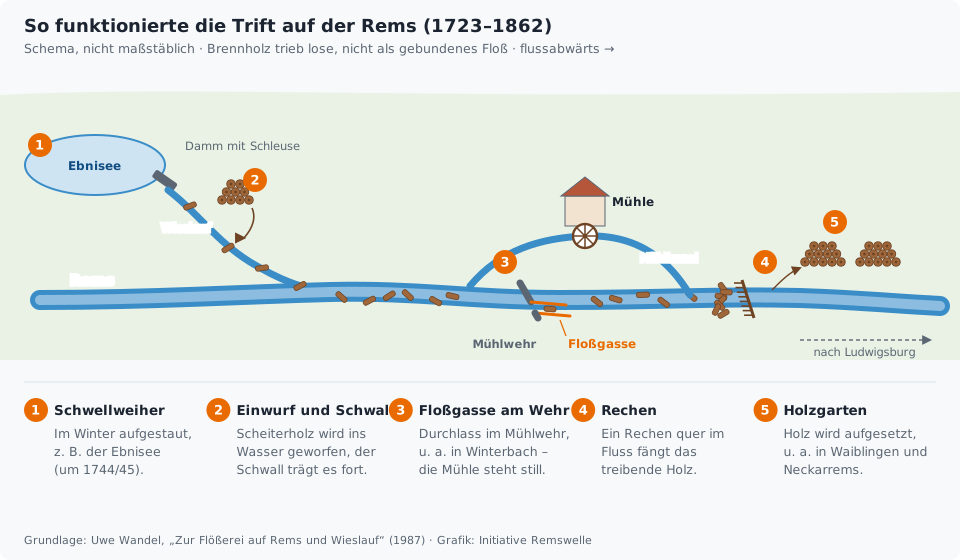
The men in the water
The drift was hard, dangerous work. The lists of 1826 name one foreman, 27 "boot men" – named after their high rafting boots – and 26 "barefooters" with simple shoes. In cold and wet, sometimes at night, they stood in the river and pulled the jammed billets apart with hooks so that no blockage formed. At the chutes this mattered most: in 1754 a day labourer was posted at the Waiblingen chute specifically to "help the wood along", that is, to prevent jams. Accidents were part of it; for two raftsmen injured in 1821 the state exceptionally covered the considerable medical costs of 67 gulden – statutory accident insurance did not yet exist.
Pay was poor, and it got poorer: in 1826 the state cut the day wages of the drift hands from 40 to 30 kreuzer and those of the boot men from one and a half gulden to one – for comparison, an eight-pound loaf of bread cost 16 kreuzer at the time. For some tasks insolvent "forest penalty workers" were drafted in; at Neckarrems even military convicts.
Winterbach in the files
Winterbach appears again and again in the history of Rems rafting – not at the margins, but in the middle of it:
- The rafting chute in the Winterbach mill weir: mentioned in 1660, listed in the official inventory of structures in 1736 – alongside Großheppach, Schorndorf, Plüderhausen and Waldhausen. → The riddle of the rafting chute
- The throwing-in of the wood happened "as a rule in the area of Schorndorf and Winterbach" – the drift effectively began on the village's doorstep.
- In 1832/33, of all people, the innkeeper of Winterbach's Krone took over the entire Rems drift as leaseholder.
- A Winterbach mason helped build the great structures in the 1740s: the new Ebnisee dam, the repair of the Walkersbach dam, and the small pond in the Steinbächle valley. → The network of flushing ponds
Nobody liked the drift
As useful as the drift was to the court, it was unpopular in the Rems valley. The millers complained about idle mills – in Schorndorf in 1717 about "six days and more", in Waiblingen around 1800 even about several weeks. The municipalities watched their firewood float off to Stuttgart and Ludwigsburg while fearing shortages themselves; a petition of 1793 describes the hardship of the "poor Rems valley man" in drastic words. The owners of fishing waters pointed to the damage to their yields. And the district description of 1851 notes drily: "The fish fry suffer from the timber floating." That sentence from an official description matters to us today: the historical use of the water took little care of the river – a yardstick against which any new use must be measured, ours included. → Wildlife of the Rems
The end came on rails
It was not the complaints that ended the drift, but technology: in July 1861 the Rems railway opened, and from then on wood travelled faster and cheaper by rail. In 1862 the Rems was drifted for the last time. In 1863 the state auctioned off the timber-yard installations. And then something happened that is worth gold for our search: in case the rafting privilege should ever be needed again, "all rafting chutes were very carefully measured and drawn". Those drawings lie in the archives to this day. → The riddle of the rafting chute
Frequently asked questions
What is the difference between rafting and drifting?
In rafting, logs are bound into rafts on which raftsmen travel – as on the Neckar, Enz or Murg. In drifting (loose-log rafting), loose, short-split firewood floats freely; nobody rides along. On the Rems there was only drifting. Traditional timber rafting was inscribed on the UNESCO list of intangible cultural heritage in 2022; loose-log drifting is not automatically covered – but the two techniques are close relatives. That is why we say: timber rafting is UNESCO cultural heritage. The timber drift on the Rems is its forgotten chapter – and the Remswelle would be its modern echo: a place where the river would carry again. If you want to dig deeper: the German Timber Rafting Association (opens in a new tab) (Deutsche Flößerei-Vereinigung, website in German) brings together rafting clubs, raft operators, museums and municipalities from all over Germany.
How long did the wood take from Winterbach to Waiblingen?
The 1830 register gives 24 to 36, often 48 hours for the whole stretch to the timber yards – depending on the water level. The wood drifted much more slowly than the water itself, because it kept catching on banks, gravel bars and weirs.
Did the drift hands stand on the floating wood?
On the Rems the files describe the opposite: the boot men stood in the water and worked with hooks. Nobody can stand on short billets. Elsewhere – in Alpine log drifting and in North American log driving – balancing on floating logs was part of the trade. More on this in the thought experiment → The first Rems surfer?
Are there still traces of the drift?
Yes: the Ebnisee is a popular destination today, remains of the Walkersbach dam still stand, and the files lie in the state archives – including one of their own about the Winterbach rafting chute. → The network of flushing ponds · → The riddle of the rafting chute
Sources: Uwe Jens Wandel, "Zur Flößerei auf Rems und Wieslauf", in: Waiblingen in Vergangenheit und Gegenwart, vol. 9 (1987), pp. 177–195 (based on the files of the Stuttgart Main State Archives, the Ludwigsburg State Archives and the town archives of Schorndorf and Waiblingen; including the millers' ordinance of 1627, the 1715 report, the 1830 register, wages and accidents) · Beschreibung des Oberamts Schorndorf, Stuttgart 1851, chapter A 5 (Wikisource): cord figures, fish fry · German Commission for UNESCO: timber rafting – intangible cultural heritage (2022) (opens in a new tab) · Deutsche Flößerei-Vereinigung e. V. (German) (opens in a new tab) · → History of the Rems
Last updated: 15 October 2026 · Initiative Remswelle