
Rems and Winterbach · River, water, nature and history
Sponge landscape Winterbach
"Sponge city" is the guiding idea with which towns prepare for heavy rain, heat and drought: not channel rain into the sewer as fast as possible, but hold it back, let it seep away, let it evaporate and release only the remainder, delayed. The German Environment Agency describes it as the umbrella concept of climate adaptation. Winterbach is not a city, and most of the water that reaches the village does not fall on roofs but on the Schurwald and the Hungerberg. So we prefer to speak of the sponge landscape: the sponge begins up on the slope, not at the downpipe. Where water falls in Winterbach and where it flows is on Water in Winterbach; this page is about where it can stay – and about a widespread misunderstanding.
What a rain weighs
Numbers help to grasp the scale. One millimetre of rain is one litre per square metre. A thunderstorm with 30 millimetres puts 30 million litres on a square kilometre – 30,000 cubic metres – roughly 25 to 30 times what fits into the pool of Winterbach's outdoor swimming baths. (Our estimate: about 560 square metres of water surface, from knee-deep to diving depth under the three-metre board, about two metres deep on average – so roughly 1,000 to 1,200 cubic metres.) The heavy rain of 19 July 2025, around 40 litres per square metre, laid about 280,000 cubic metres on the catchment of the Lehenbach alone (7.1 square kilometres) – more than half of what the Lehenbach reservoir can hold back. On a house roof of 100 square metres the same rain delivers 4,000 litres.
How high does the water stand? A litre is a cube with sides of ten centimetres. Spread over one square metre, it stands one millimetre high. 100 litres per square metre therefore means: if nothing ran off, soaked away or evaporated, the water would stand ten centimetres deep on every square metre – after the thunderstorm of July 2025 with about 40 litres, four centimetres, everywhere, on meadow, roof and road.
What matters is time. The same amount can be harmless or dangerous. 100 litres per square metre fall in Winterbach in a wet month without any trouble; if they fall within an hour, that is severe weather of the highest level. The German Weather Service (DWD) warns of heavy rain from 15 litres per square metre in one hour or 20 litres in six hours; more than 25 litres in one hour count as severe weather ("very heavy rain"), more than 40 litres in one hour or 60 litres in six hours as extreme severe weather. Longer rain has its own thresholds: continuous rain begins at 30 litres in 24 hours, extremely abundant continuous rain at more than 80.
Rain calculator: how much water is that?
Warning levels: German Weather Service (DWD), warning criteria for heavy rain (1 and 6 hours) and continuous rain (12 to 72 hours).
No technology can catch these quantities. What catches them is the landscape: the soil that takes the water in, the vegetation that slows it and evaporates it, the floodplain into which the river may spread.
Where water stays: forest, meadow, orchards, floodplain
The slope is the first sponge. Forest slows the rain in its crowns and evaporates around two thirds of the annual precipitation again; a meadow with a dense root mat and humus-rich topsoil takes in the rain of a thunderstorm as long as its soil is not dried out and compacted; orchard meadows combine both. Which of the two is the better sponge depends on the question you ask – a single event on dry soil, or the annual balance – and we want to measure it on the Hungerberg. → Forest or meadow?
The floodplain is the second sponge. Below the village the Rems has had room again since the restoration in 2018; in June 2024 the district office deliberately flooded these areas to relieve the retention basin. Every area in the floodplain that stays open is storage. → Restoration at Winterbach
The village is the third sponge, and the smallest: gardens, trees, unsealed yards and swales hold back the rain that falls on roofs and streets. This is where the classic sponge city starts – and where the misunderstanding begins.
The Winterbach cistern paradox
People build a cistern as a precaution – so that less water rushes into sewer and stream in heavy rain. Municipalities fund cisterns for the same reason, and development plans require them. And yet they often fail to help exactly when it matters. We call this the Winterbach cistern paradox: the effect is observed elsewhere too; with the Rems gauge record since 1931 we show it here for Winterbach.
The cistern is regarded as the emblem of the sponge city: collect rain from the roof, water the garden in summer, relieve the sewer during heavy rain. The first is true, the second too. The third is true only if the cistern has room at the moment of the rain. A full cistern holds back not a single drop.
When is it full? Whenever rain has already fallen beforehand and nobody has drawn water – that is, in winter and spring, when no one is watering, and after every wet week. When do the floods come? We analysed the 95 years of gauge data of the Rems at Schorndorf for exactly this.
The season. Of 94 annual peak flows between 1931 and 2026 (years with gaps in the record excluded), 69 fall in the months November to March, 12 in June and only 5 in the months July to September. Of the 26 annual maxima above 80 cubic metres per second, 20 lie in the months December to March, one in October, only five in the summer half-year. A Rems flood is a winter and spring event – exactly the time when every garden cistern is full to the brim.
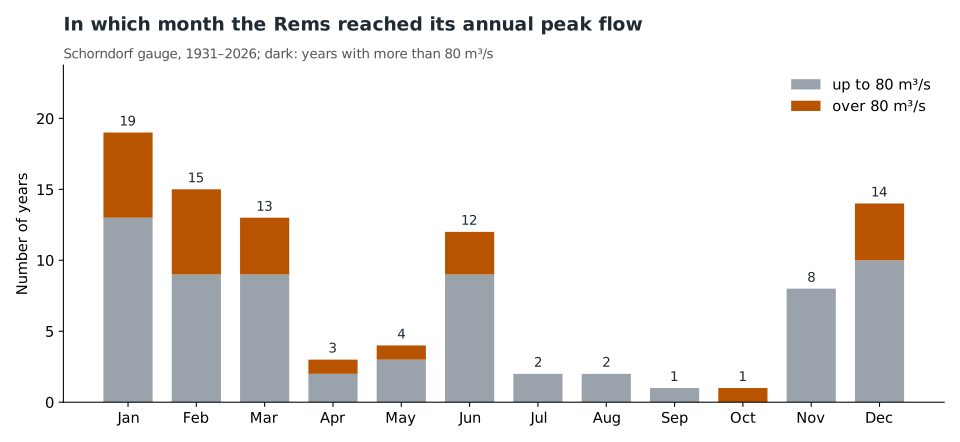
How to read the chart: For every year since 1931 we picked the one day on which the Rems at Schorndorf carried the most water – the annual flood. Then we counted in which month that day fell. Each bar is a month, its height the number of years whose flood fell in that month: 19 years had their largest flood in January, only one in September. Orange is the share of years in which that flood was a big one, with more than 80 cubic metres per second – around fifteen times the mean flow. Reading example, June: 12 years had their annual flood in June, three of them a big one (among them 2013 and 2024). What you see: the tall bars stand on the left and right, from November to March; in the middle, from July to September, there is almost nothing. The big floods (orange) concentrate even more on December to March. In exactly these months nobody waters the garden – every garden cistern is full then.
The run-up. For the 25 largest floods since 1931 we compared the flow of the thirty days beforehand with the long-term mean of the respective month – the flow is a good proxy for how wet the catchment already was. In 16 of the 25 events the run-up lay above the monthly mean, often far above: in June 2024 at 2.4 times (on 17 and 18 May, 47 and 65 cubic metres per second had already flowed), in January 2011 at 2.1 times, in February 1970 at 2.3 times; three more were just below. The six floods with a clearly "dry" run-up – among them the largest of 1956 and 1990 – all fall in the months December to March, when snowmelt and frozen ground take over the role of the preceding rain. Then, too, nothing stores anything.
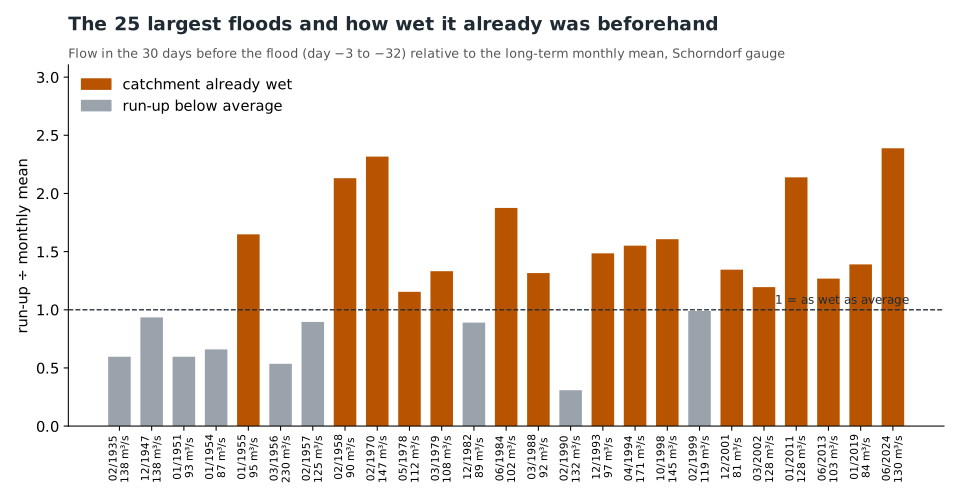
How to read the chart: Each bar is one of the 25 largest floods since 1931, from left to right in order of time; below the bar are month, year and the flow on the day of the flood. The height of the bar says how wet it already was beforehand: we divided the mean flow of the thirty days before the flood (excluding the last three days, when the flood was already building) by the long-term mean of the respective month. A value of 1 (dashed line) means: beforehand, as much water flowed as is usual in that month. A value of 2 means twice as much – the catchment was already wet, the soils saturated, the stores full. Orange are the floods with values above 1, grey those below. Reading example, far right: before the flood of 1 June 2024 (130 cubic metres per second), 2.4 times as much water flowed in May as in a normal May. What you see: 16 of 25 bars are orange, and the grey ones all fall in the months December to March, when snowmelt and frozen ground can trigger a flood even without a wet run-up.
The German Weather Service confirms the pattern for 2024: in May around 30 per cent more rain had fallen than usual, the soils could "absorb only little more water", then on 31 May and 1 June 50 to over 100 millimetres fell widely within 24 hours. The Schorndorf/Winterbach retention basin was full to the brim twice – "touch and go", said the mayor. And so were the cisterns in the village.
What the research says. A report of the German Environment Agency and studies from Britain and Italy reach the same conclusion: the retention of a cistern depends solely on the free volume at the moment of the rain. If the average fill level is above about 75 per cent, the protective effect approaches zero. In a Berlin residential block with an average fill level of 19 per cent, the tanks held back 78 per cent of the rain; in a commercial estate with over 80 per cent fill level, practically nothing.
The answer is retention. That is why the profession distinguishes two designs. The storage cistern collects water for watering and is full when it matters. The retention cistern has an additional storage space that empties slowly through a throttle into the ground or the sewer – and is therefore empty before the next rain. Only this one is heavy-rain precaution. Those who want both need both: a usable volume below, a retention volume above.
Slide through the year: what a cistern holds back
Rain: 40 litres per square metre on 100 square metres of roof = 4,000 litres.
Storage cistern (5,000 litres)
- Fill level
- Free volume
- Holds back of the 4,000 litres
Retention cistern (4,000 litres retention space with throttle)
- Fill level
- Free volume
- Holds back of the 4,000 litres
Assumed fill levels: an example, not a measurement (see table). The retention cistern empties slowly through its throttle after each rain and is therefore ready for the next one.
| Month | Watering demand | typical fill level of a storage cistern | free volume in a 5,000-litre tank | retention at 40 l/m² on a 100 m² roof (4,000 litres) |
|---|---|---|---|---|
| January–March | none | full | 0 | 0 % |
| April–May | low | almost full | up to 1,000 | up to 25 % |
| June–August | high | half to empty | 2,500–5,000 | 60–100 % |
| September–October | low | almost full | up to 1,000 | up to 25 % |
| November–December | none | full | 0 | 0 % |
Slider and table are an example, not a measurement: it shows that the cistern helps exactly when it is least needed – in summer, when the thunderstorms are fierce but the Rems does not rise – and does nothing when the Rems flood comes.
What is a retention cistern?
A retention cistern is a cistern with two storeys. The lower one holds the water you want to use – for watering, the toilet or the washing machine. The upper storey is the retention space: it should be empty when the rain comes. In between sits the throttle, a small outlet at the level up to which the usable water reaches.
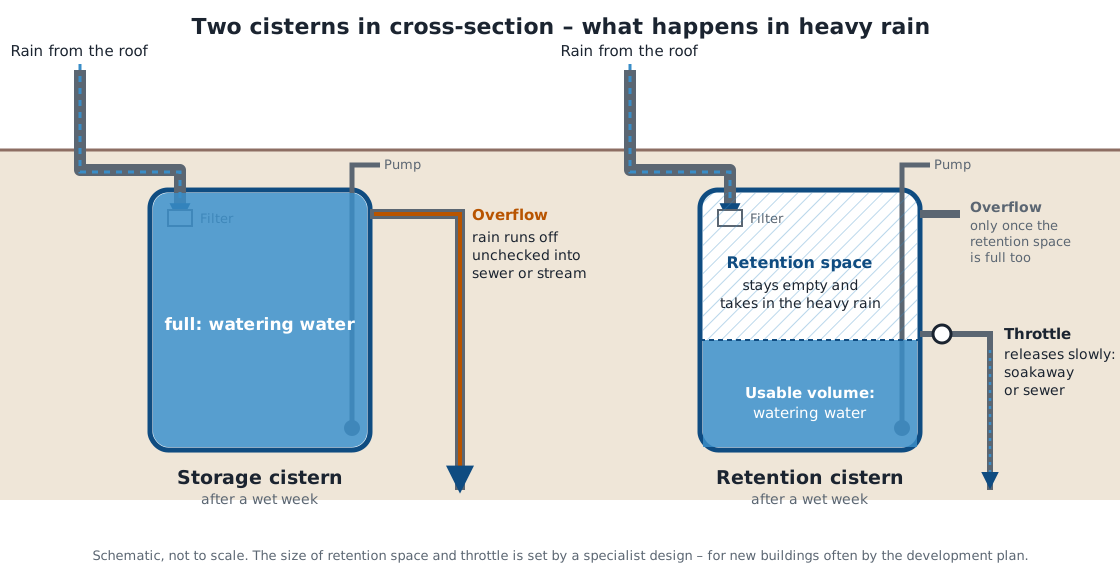
How to read the diagram: On the left an ordinary storage cistern, on the right a retention cistern, both after a wet week in which nobody watered. Blue is water, hatched is empty space. On the left everything is blue: whatever now comes from the roof goes straight on through the overflow into the sewer or stream – as if the house had no cistern. On the right only the lower part is blue. The upper part is empty because the throttle released the water above its level slowly after each rain. If heavy rain now comes, it fills this space first.
How it works in heavy rain.
- The rain runs from the roof through a filter into the cistern. The usable volume is, as always, more or less full.
- The water level rises into the retention space. Only a small amount flows out through the throttle – most of it stays in the tank for the time being.
- After the rain, the retention space drains through the throttle within a few hours, depending on the design into the sewer or, better, into a soakaway hollow in the garden. The usable water below remains.
- Only if a rain is even larger than the retention space does the emergency overflow come into play.
A worked example. A roof of 100 square metres delivers 4,000 litres at 40 litres per square metre. If the cistern has 4,000 litres of retention space above the usable water, it catches this rain completely. If the throttle releases 0.1 litres per second, the retention space is empty again after a good eleven hours. Instead of a surge of 4,000 litres in half an hour, the sewer or stream then receives a trickle spread over half a day. Which sizes are right in a given case is calculated by a specialist designer; some municipalities prescribe the retention space and throttled outflow per square metre of roof.
Is there one for your own house? Yes. Several manufacturers offer cisterns for detached and semi-detached houses as a combination of usable and retention volume, as well as pure retention tanks without usable water. According to manufacturers, a throttle outlet can be retrofitted to some existing cisterns; the upper part of the existing tank then becomes the retention space, and the usable volume shrinks accordingly. The price: less watering water for the same tank size – or a somewhat larger tank.
Retention and infiltration together. A retention cistern does most good when its throttle discharges not into the sewer but into a hollow or trench in the garden: the heavy rain is slowed down and the water still stays on the plot and replenishes the soil. Whether the ground can absorb it depends on the subsoil – in Winterbach sandstone, marl and floodplain soil alternate within short distances. Some of the municipality's development plans therefore require that infiltration "be provided for" "insofar as the results of the hydrological survey permit".
What Winterbach can learn from the cistern paradox
How it is regulated today. Winterbach supports cisterns: under the municipality's nature and environmental protection funding programme (since 25 March 2026), a cistern in an existing building with at least two cubic metres "for use as service water" receives 300 euros. In new development areas a cistern is mandatory – the Eichenwäldle extension, the Riedwiesen and Schorndorfer Straße 7–13 all state that roof water is to be "collected as service water by means of a cistern", at least five cubic metres per building. The explanatory statements for Eichenwäldle and Riedwiesen expressly name relief of the sewer system in heavy rain as a second purpose. That is a good start: every one of these cisterns saves drinking water. None of the rules so far requires a retention space with throttle – and that is exactly where the paradox bites.
What everyone can take from it.
- If you are building new, plan the cistern as a combination from the start: usable water below, a retention space with throttle above, ideally draining into a hollow in the garden.
- If you already have a cistern, ask the manufacturer or installer whether a throttle outlet can be retrofitted.
- If you only want to water the garden, you now know: your cistern saves drinking water but gives little protection against floods in winter and spring.
What funding programmes and development plans can achieve. Where a municipality funds or requires cisterns, the effect in heavy rain could be secured with little effort: with a retention space with throttle as a condition or as a bonus in the funding, and as a stipulation in future development plans – the size per square metre of roof is then set by the drainage design. This fits the heavy-rain risk management that the Water Board and the municipality have begun: under the state guideline, the hazard maps are followed by a risk analysis and an action plan. → Heavy rain in Winterbach
What this means for the Rems – a thought experiment
The wave is not a sponge-city measure, and we do not claim that it contributes to flood protection. Conversely, though, there is a connection that interests us surfers: a landscape that holds water releases it more slowly. What seeps into forest soil, meadows and floodplain runs off over days and weeks as hillside water and spring discharge – and keeps the Rems above the limit at which the wave can run for longer after rainy spells. In a what-if calculation with our gauge data that amounts to one to three weeks a year. For the wave, what counts above all is the catchment upstream; the Winterbach slopes are a small part of the 418 square kilometres. But the direction is clear: every hectare that holds water helps the river, not just the cellar. → What does all this have to do with surfing? · → River flow of the Rems · → The Rems is getting warmer
What everyone can do on their own plot
- Lead rainwater from the roof not into the sewer but into the garden: a shallow swale where it can seep away holds back more than any butt
- Anyone building a cistern builds it with retention volume and a throttled outlet – then it helps in February too
- If your cistern has no retention space, you can make room yourself: when long or heavy rain is forecast – especially in the winter half-year, when the cistern is otherwise brim-full – drain part of it and let the water soak into the lawn or a bed. Not onto frozen or already wet ground and not into the sewer, or the water is straight back in the stream. → When the Rems runs low
- Keep or make yards, parking spaces and paths permeable; every unsealed area takes in rain
- Plant and keep trees: a large tree slows the rain, evaporates hundreds of litres a day in summer and cools the yard
- On the slope: mow meadows instead of letting them scrub over, do not compact the soil, keep walls and banks – they hold water and soil on the slope
What this means for the Remswelle
We surfers want a river that does not burst its banks in winter and does not run dry in summer. Both depend on the same landscape. That is why we look not only at the weir but at the slopes, streams and meadows the water comes from. → Water in Winterbach · → Flood protection
Frequently asked questions
What is a sponge city?
A guiding idea in urban planning: rainwater is held back, seeps away and evaporates where it falls, instead of being channelled into the sewer as fast as possible. That reduces flooding in heavy rain, cools in heat and replenishes groundwater in dry periods.
What is a retention cistern?
A cistern with a retention space above the usable water. A throttle slowly releases the water above the usable volume after each rain, so that the retention space is empty again before the next heavy rain. It therefore holds back rain even when the watering water below is full.
Does a cistern protect against heavy rain?
Only if it has room at the moment of the rain. A cistern used for watering is usually full in winter and spring – and almost all the big Rems floods fall in that period. Protection comes only from a retention cistern with a throttled outlet that empties by itself.
When do the floods of the Rems come?
According to 95 years of gauge data, mostly from November to March and in June; in high summer and early autumn almost never. The summer thunderstorms hit the small streams, not the Rems.
What are 30 millimetres of rain?
30 litres on every square metre. On a square kilometre that is 30 million litres, on a house roof of 100 square metres 3,000 litres.
What do 100 litres per square metre mean?
On every square metre the water would stand ten centimetres deep if nothing ran off, soaked away or evaporated: 100 litres are 0.1 cubic metres, spread over one metre by one metre. Whether that is harmless or dangerous depends on time: spread over a month it is a wet month, within one hour extreme severe weather.
When does the weather service warn of heavy rain?
From 15 litres per square metre in one hour or 20 litres in six hours (warning level 2). More than 25 litres in one hour or 35 in six hours count as severe weather, more than 40 litres in one hour or 60 in six hours as extreme severe weather. The rain calculator on this page places any amount. → Heavy rain in Winterbach
Sources
- Municipality of Winterbach, "Freibad" (combined pool 25 m, 560 m²); pool depth as reported by the initiative, volume our own estimate
- LUBW, Schorndorf gauge, daily mean discharge 1931–2026 (data from the environmental information system of the LUBW); own analysis, method under The Rems in figures
- German Weather Service (DWD): hydro-climatological assessment of the heavy and persistent rainfall in southern Germany, late May/early June 2024
- German Environment Agency (UBA): sponge city – concept and recommendations (2026); report on rainwater management and flood precaution (Niederste-Hollenberg et al.)
- Quinn, Rougé & Stovin (2021), United Kingdom; Palla & Gnecco (2022), Italy/France: retention performance of rainwater tanks as a function of fill level
- Gemeinde Winterbach: funding programme for nature and environmental protection (from 25.03.2026), no. 4.2 cistern; development plans "Eichenwäldle – Erweiterung" (text part no. 2.9 and explanatory statement), "Riedwiesen" (2021) and "Schorndorfer Straße 7–13", local building regulations on surface water; accessed 03.10.2026
- Deutscher Wetterdienst (German Weather Service): warning criteria for heavy rain and continuous rain (accessed 03.10.2026), www.dwd.de/DE/wetter/warnungen_aktuell/kriterien/warnkriterien.html
- Municipality of Winterbach: heavy-rain risk management and hazard maps (2025); Zeitungsverlag Waiblingen, 19/20 July 2025 (heavy rain, Lehenbach); Winterbach fire brigade, flood of June 2024; Stuttgarter Zeitung, June 2024
- Thünen Institute, agricultural soil inventory (carbon stocks of grassland, arable land, forest); waldwissen.net: how much water does forest soil store?
Last updated: 15 October 2026 · Initiative Remswelle