
River waves · building, running, surfing
Surfing without a wave
Anyone who wants to surf in the Rems valley has a problem: the sea is far away, and so is the nearest river wave. Surfers have therefore always practised on land – on wheels, with momentum from their own body or with the wind. We present four of these sports here. They have one thing in common: you need neither water nor a wave, just a smooth surface and some practice. And everything you learn along the way helps later on the wave.
Surfskate: the wave under your feet
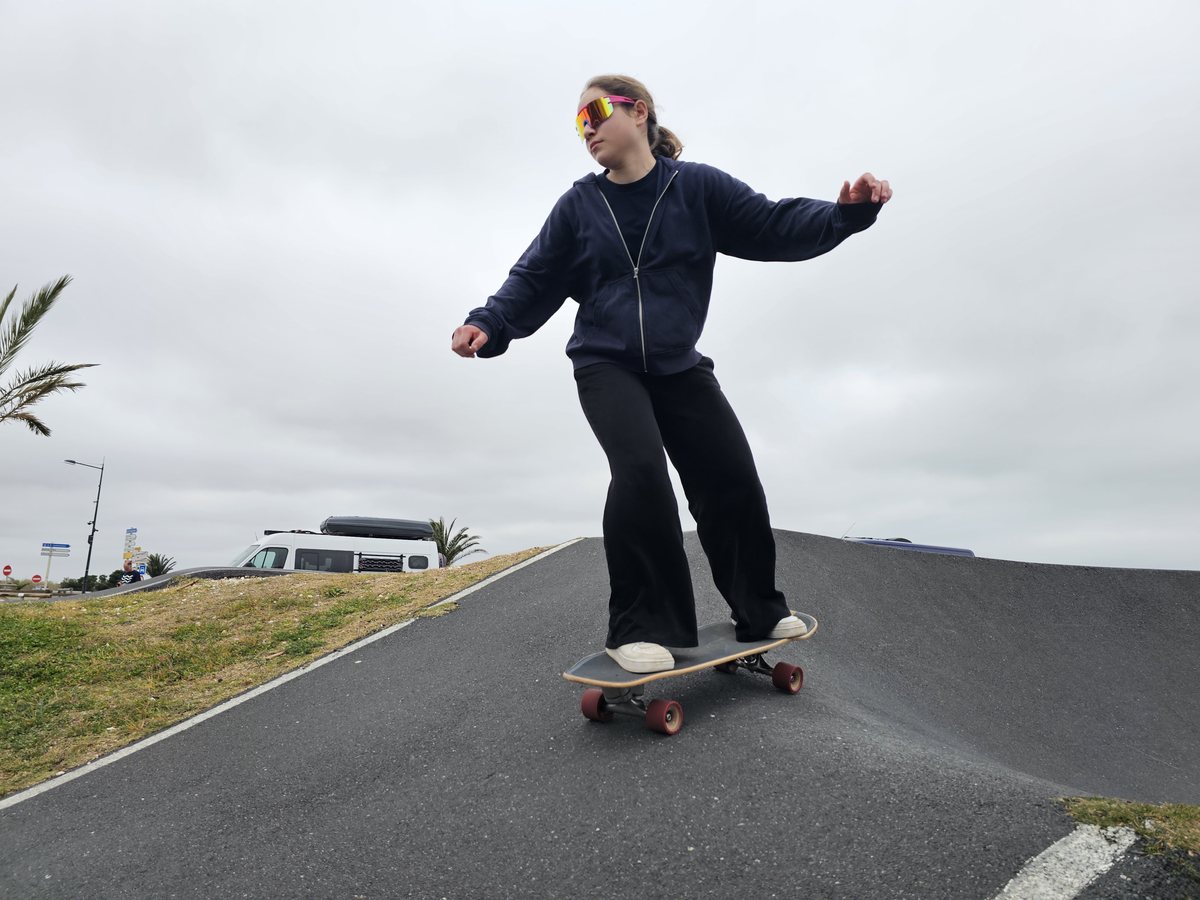
A surfskate is a skateboard with a particularly mobile front truck. It sits on a pivoting arm and swings out much further than a normal skateboard truck. This makes tight turns possible as on a surfboard, and – most importantly – you move forward without pushing. The surfskate was invented by Californian surfers: in 1996 Greg Falk and Neil Carver founded a company for it in Venice.
Pumping instead of pushing. Instead of pushing off the ground with one foot, both feet stay on the board. You bend your knees, straighten up, turn hips and shoulders into the curve and out again. Every swing gives momentum. Surfers call this "pumping", and it is exactly the movement with which you pick up speed on a wave. Experienced riders cover kilometres this way without touching the ground.
What you learn. Shifting weight from heel to toe, looking into the turn, turning from the hips rather than the arms, staying loose in the knees. These are the basics of every turn on a wave – from a simple bottom turn to a cutback. Surfers therefore use the surfskate as dry training for the wave.
What you need. A surfskate, a smooth surface without traffic, a helmet and pads for knees, elbows and wrists. At the beginning a slight slope helps, or a friend who gives you the first push.
Pump track: waves of asphalt
A pump track is a circuit of small humps and banked turns, about one metre wide, on which you move forward without pedalling or pushing: you press the board or bike down into each dip and unweight it on each crest. Pump tracks began as practice courses for BMX and mountain bike riders; today's form came from Australia around 2003. Once built of earth and clay, most new tracks are asphalted and can therefore be used all year round.
A pump track is the best place for a surfskate: every hump of the course is a small wave to pump. Almost anyone can ride it – on a balance bike, scooter, BMX, mountain bike, skateboard, surfskate and, on narrow tracks, inline skates. That makes pump tracks meeting places for children and young people. Why we can well imagine one in Winterbach is explained under children and young people.
Wing skating: riding with the wind
In wing surfing you hold an inflatable wing freely in your hands; it is connected to no mast and no board. On the water you stand on a board, often with a hydrofoil underneath. On land the same works on inline skates, a longboard, a surfskate or a mountainboard with pneumatic tyres. This is called wing skating.
What you need. A wing of about four to five square metres, a large, smooth, open surface – an empty car park, a paved area without traffic – and light to moderate wind. Around 3 Beaufort is enough, a wind in which leaves and small twigs are constantly moving. In Winterbach such a wind blows on about half of all days. → Wind and weather in Winterbach A helmet and pads are part of it, because falls happen on asphalt.
What you learn. Reading the wind: where it comes from, how it picks up and drops, how to set the wing on a beam reach, take it over your head and switch it to the other side. Anyone who can do this on land has a much easier time on the water – handling the wing is almost the same there.
Street surfing: the windsurf sail on wheels
Even older is the idea of putting a windsurf sail with mast and boom on a large skateboard or landboard. As in windsurfing, the sail is connected to the board by a joint; you steer by tilting the sail forwards or backwards and putting the board on its edge. Street surfing needs a little more space than wing skating but works in similarly light wind. Here too: only on open surfaces without traffic, with helmet and pads.
What this brings for a river wave
On a river wave you stand on a mound of water that does not move while the water rushes through underneath. To surf it, you have to guide the board on its edge from the first moment, shift your weight and stay on the wave with small pumping movements. That is exactly what you learn on a surfskate and a pump track. Wing and windsurf sail train the eye for currents – in the air as in the water – and balance on a board that moves beneath you.
That is why these sports belong to the Remswelle for us: as training while the wave does not yet exist, and as a complement on the many days when the Rems carries too little water. → River flow of the Rems · → How to surf a river wave
Frequently asked questions
What is the difference between a surfskate and a longboard?
A longboard is a long skateboard for relaxed gliding and long distances; you push it with your foot. A surfskate is shorter and has a particularly mobile front truck with which you can make tight turns and pump without pushing.
Does surfskating really help with surfing?
The movement is the same: bending and straightening the knees, turning from the hips, shifting weight between heel and toe. Surfskating does not replace the feel for water and wave, but it lets you practise the body movement as often as you like – even when there is no surf spot nearby.
How much wind do you need for wing skating?
To begin with, around 3 Beaufort is enough, about 7 to 10 knots. In stronger wind it quickly gets fast – then better take a smaller wing.
Can you ride with a wing or sail on the road?
No, that does not belong in road traffic. Practise on open surfaces without cars and pedestrians, such as empty car parks – with the owner's permission.
From what age is it possible?
On a pump track even nursery-age children ride on balance bikes. Children learn surfskating as soon as they stand safely on a skateboard. Wing and sail need some strength in the arms and core and a wing that suits your size.
Sources
- Wikipedia (German): "Surfskateboard" (truck, Carver Skateboards, pumping), "Pumptrack" (design, history, vehicles), "Wingsurfen"; accessed 03.10.2026
- surf-Magazin: Wingfoiling on tarmac – tips for wing skating (wing size, wind, protective gear)
- Wind in Winterbach: own analysis, Open-Meteo/ERA5 1991–2025 – see Wind and weather in Winterbach
Last updated: 15 October 2026 · Initiative Remswelle