
Rems and Winterbach · River, water, nature and history
The forgotten wave of Winterbach
Of timber rafting, water retention and the return of the Remswelle
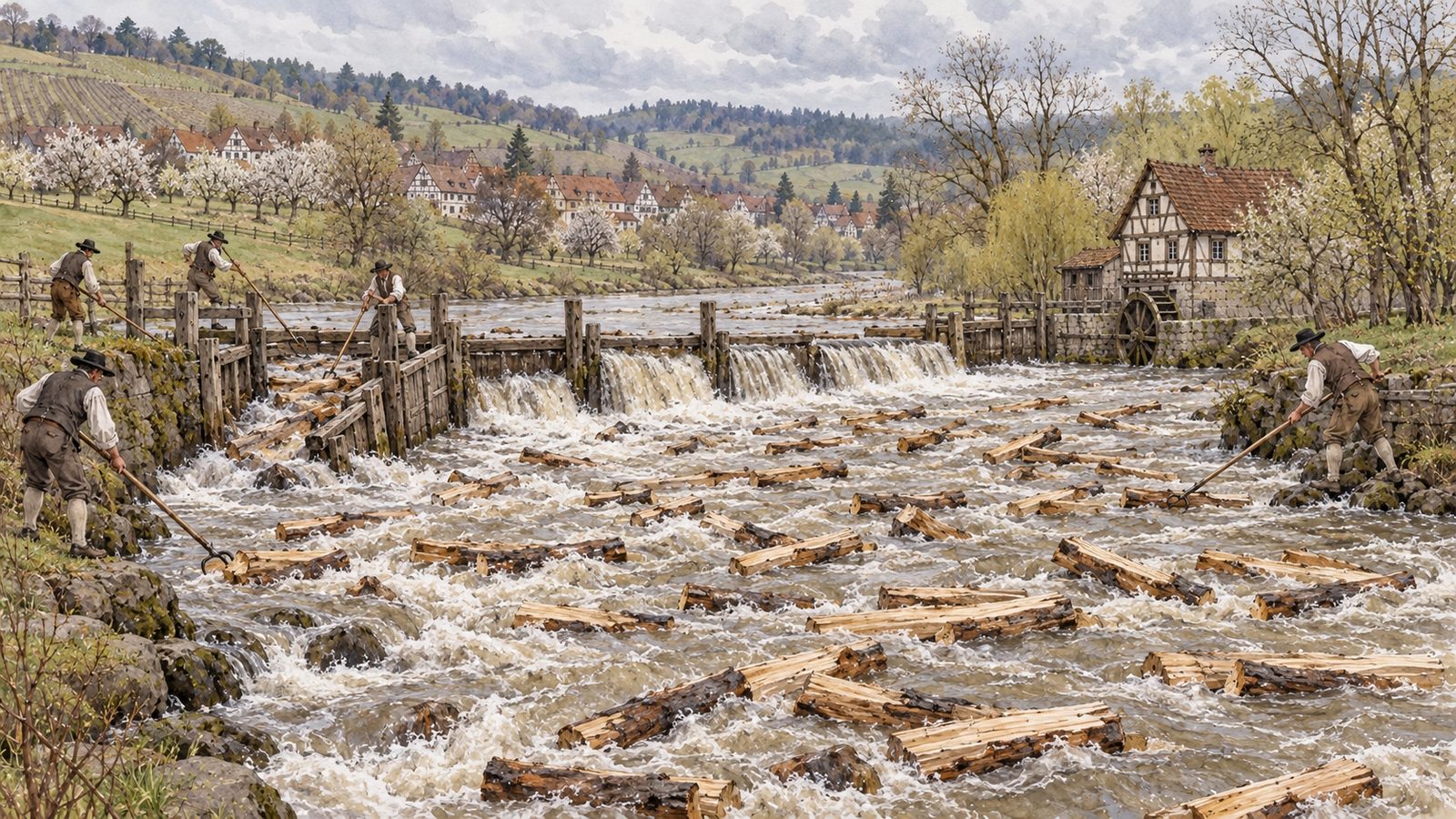
Was the Rems surfed 300 years ago? The question sounds absurd. But the longer we read the old files, the less absurd it becomes. Three things are documented: for over a century, firewood drifted down the river through Winterbach. Water was collected in artificial ponds and released on purpose to carry it. And in the Winterbach mill weir there was a timber-rafting chute – a narrowed passage the water shot through. Whether a surfable wave ever stood behind it, and whether anyone ever tried to ride it, we do not know. Which is exactly why we are searching for traces.
Where our search stands
The search in four chapters
→ When the Rems carried firewood – How wood from the Swabian Forest reached Ludwigsburg: the drift of 1715–1862, the men standing in the water, the mills at a standstill – and what the files say about Winterbach.
→ The network of flushing ponds – The Ebnisee, the Walkersbach pond and their smaller siblings: how water was held back 280 years ago to be used in one go. All of it flowed through Winterbach.
→ The riddle of the rafting chute – The detective story: a mention from 1660, an inventory from 1736, a file in the State Archives – and the question of where in the old mill weir the chute sat.

→ The first Rems surfer? – The thought experiment to finish with: could it have worked? What raftsmen elsewhere did on floating timber, who rode Europe's first river wave in 1955 – and why we say honestly: nothing is documented.
Why this story will not let us go
The drift was the opposite of what we want today – and that is exactly why the look back is worth it. Back then, water was collected in ponds in order to be wasted in bursts: a few days of surge, then it was gone. The district description of 1851 even records that "the fish fry suffer from the timber floating". Today we think the other way round: not collecting and releasing water, but strengthening the landscape so that it holds water and releases it slowly. Stored water released in surges is not a concept for the Remswelle – not from the Ebnisee, not from anywhere. The wave is meant to run on the water the Rems carries by itself. How landscape and surfable days are connected is the common thread of our pages: → More flow for the Rems
Frequently asked questions
Was the Rems really surfed?
We do not know – and we do not claim it. Documented are the timber drift (1715–1862), the flushing ponds and the Winterbach rafting chute. Whether a surfable wave stood there, and whether anyone ever tried to ride it, is open or undocumented. Our pages keep this separate: what we know, what we suspect, what we still want to find out.
What is a rafting chute?
An opening or channel in a mill weir through which the drifting wood, together with the water, was guided past the weir without damaging the mill. The Württemberg millers' ordinance of 1627 obliged weir owners to open such chutes and let the wood pass "unhindered".
Does the initiative want to impound and release water like back then?
No. We tell the story of the flushing ponds as history. We are not planning any surge operation for the Remswelle – the wave is meant to run when the Rems carries enough water by itself. More surfable days are something we want to achieve through a landscape that stores water and releases it slowly. → More flow for the Rems
Where does the knowledge on these pages come from?
From the research paper by Uwe Jens Wandel (1987), who worked through the files of the state archives, from the district descriptions of 1845 and 1851, and from the online finding aids of the Baden-Württemberg State Archives. That is where we found the file "Floßgasse zu Winterbach" – we have not yet been able to inspect it. Every page lists its sources.
Sources: Uwe Jens Wandel, "Zur Flößerei auf Rems und Wieslauf" (On timber rafting on the Rems and Wieslauf), in: Waiblingen in Vergangenheit und Gegenwart, vol. 9 (1987), pp. 177–195 · Beschreibung des Oberamts Schorndorf (district description), Stuttgart 1851, chapter A 5 (Wikisource) · Beschreibung des Oberamts Welzheim, Stuttgart 1845, chapter A 2 (Wikisource) · Baden-Württemberg State Archives, Ludwigsburg State Archives, F 120 Bü 153 "Floßgasse zu Winterbach" (online finding aid, permalink (opens in a new tab)) · → History of the Rems
Last updated: 15 October 2026 · Initiative Remswelle